OEM & Co-packing
Turning a Restaurant Dish Into a Retort Pouch: A Co-Packer Guide
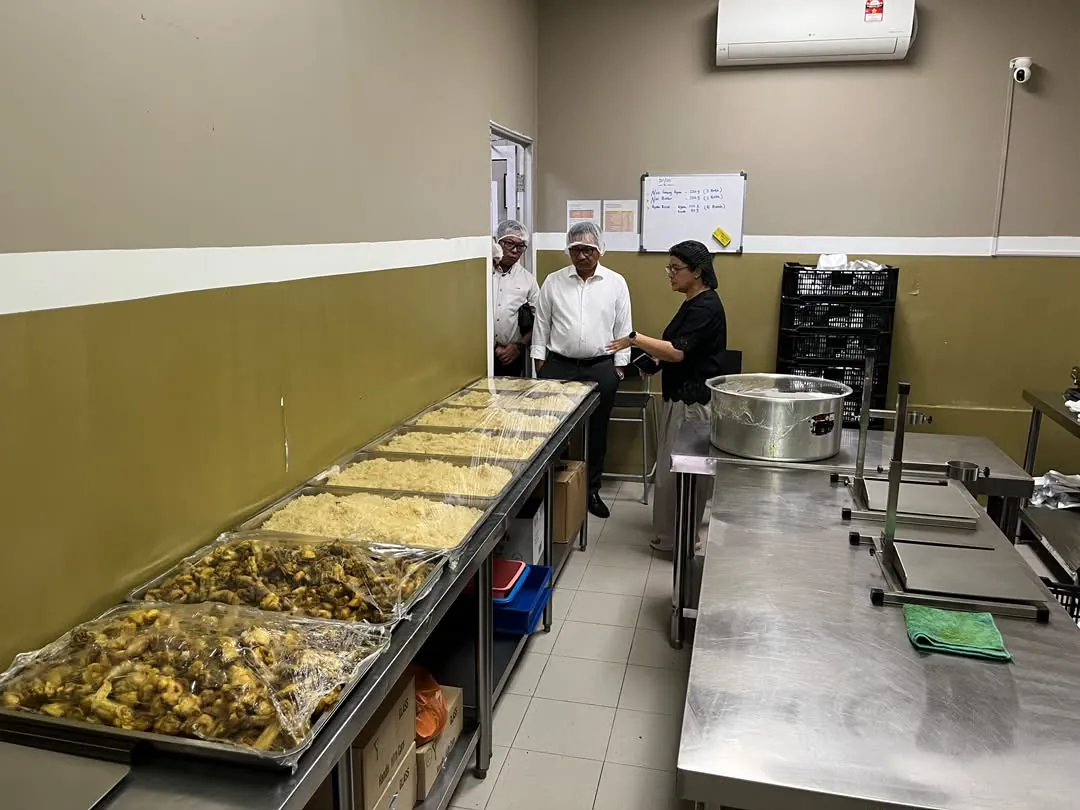
The preparation room at DapoGo's Melaka Halal Hub factory: cooked rice and lauk before they are filled into pouches.
Yes. A halal co-packer can cook your restaurant’s recipe and pack it in shelf-stable pouches under your name, no factory needed. The co-packer must hold an OEM halal certificate, but neither that nor your premises certificate covers the pouch, which needs its own product certificate; a brand owner may apply. DapoGo starts at a RM250 consultation, an R&D sample from RM3,500 and a 300–500 pouch pilot.
This guide is for restaurant, cafe and catering owners whose regulars keep asking to take one dish home, or to send it to family overseas. It is part of DapoGo’s halal OEM and co-packing series, written from our own retort factory at Melaka Halal Hub, Serkam, running since June 2026. We cook and sell our own ready-to-eat lauk there too, so these are questions we work through on our own line.
The short version
- Your restaurant is a food premises; a pouch made by a factory is a product. JAKIM certifies them under different schemes.
- A brand owner can apply for the product certificate itself.
- Your recipe has to be shared with the factory, and an agreement protects it only partly.
- Start with one dish and one pilot batch, not the whole menu.
On this page9 sections
Can a restaurant sell its dishes in pouches without a factory?
Yes, through a co-packer, which Malaysians usually call an OEM factory. JAKIM’s 2020 halal certification manual requires such a factory to hold a halal certificate (SPHM) under the contract-manufacturing (OEM) scheme before it may make products for other companies, and requires a brand owner applying for halal certification to check that certificate first. The manual also requires a contract, written agreement or mutual agreement between the factory and the brand owner.
Your restaurant is that brand owner. Under regulation 11(1)(j) of Malaysia’s Food Regulations 1985, a locally made pack must name the manufacturer or packer, or the owner of the rights of manufacture or packing, with a business address. That is where your restaurant’s name goes, provided your contract gives you those rights. The full list of what a pouch must show is in our packaged food labelling guide.
Some co-packers that court restaurants make kitchen supplies instead: cooking pastes, sauces and marinades in large commercial packs for the outlet’s own kitchen. A pouch your customer heats and eats is a different product.
Does your restaurant’s halal certificate cover the pouch?
No. JAKIM’s manual lists restaurant and cafe operators under the food premises scheme, and a premises holder applies for all menus served at its premises. A pouch cooked by a factory is a product: to carry the halal logo it needs its own certificate under the food and beverage product scheme, where brand owners are among the eligible applicants.
| Point | Food premises scheme | Food and beverage product scheme |
|---|---|---|
| Who applies | Restaurant or cafe operator | Includes the brand owner |
| What it covers | Menus served at the premises | The manufactured product |
| Where the logo goes | Restaurant entrance | Product packaging |
| Fee per year | RM100 per premises | RM100 (micro) or RM400 (small) |
| Valid for | Two years | Two years |
The manual’s OEM section confirms that the factory’s own scheme cannot be used as halal certification of what it makes, so agree with the factory who applies. The product fee follows annual sales: RM100 for a micro company selling under RM300,000 a year, RM400 for a small one. JAKIM makes the final call; how halal sits beside MeSTI and HACCP is in MeSTI, halal or HACCP.
Which dish should go into a pouch first?
The one customers already ask to buy. A dish your regulars already want to take home, or send to family overseas, has demand you can see at your own counter, and that is worth more than a menu item you hope will sell.
Then expect the dish to change a little. NC State Extension’s US co-packer guide warns that scale-up of production from the home kitchen to the first plant trial may produce unsaleable or unusable product
, because the rate of heating, stirring, time held at high temperature and pumping can affect how ingredients behave and how the food looks. What usually shifts is covered in home recipe to retort pouch.
How the retort process works is in what is retort processing. If you already freeze dishes for other outlets, DapoGo’s OEM brochure lists frozen-to-retort conversion among the work it does; the trade-offs are in retort vs frozen vs vacuum.
What will a co-packer ask your kitchen for?
A written recipe, a target price and a decision on the label. A factory cannot cook by feel, and NC State Extension tells founders to Bring your specifications and checklist to your first meeting with the copacker
. Our retort co-packer checklist covers your side. For a restaurant, that means:
- The recipe written in grams, with the cooking order and how long each stage runs.
- A target price per pouch. Even a rough number helps the factory suggest ingredient grades and a pack format that fit it.
- Who handles the label and the halal application. On DapoGo’s rate card, artwork, lab tests, nutrition facts, barcode and the halal application are excluded unless stated.
- Where the pouch will sell: your counter, delivery apps, an online shop, or abroad.
Wherever it sells in Malaysia, the required label words on food packed here must be in Bahasa Malaysia; regulation 10 of the Food Regulations 1985 allows translations to be added. KKM’s label review costs RM250.00 per application, with a 15-day client charter.
Is your signature recipe safe with a co-packer?
Partly. NC State Extension says: Confidentiality may be a problem as formulations, ingredients and product specifications must be shared with the copacker
, and This information can be protected to some degree with agreements, but confidentiality can never be assured
. Some US co-packers limit confidentiality agreements to written specifications, formulations, pricing and customer information, and most will not sign a non-compete.
The useful part for a Malaysian restaurant: JAKIM already requires a written agreement between factory and brand owner, so use that document to state who owns the recipe and what counts as confidential. The difference between your own recipe and a factory formula is in private label or your own recipe.
What does it cost to start with DapoGo?
A restaurant’s dish is the restaurant’s own recipe, so it falls under the custom R&D sample, from RM3,500 per SKU, after a RM250 consultation. Payment is a 70% deposit and 30% before delivery or stock release; the R&D fee is non-refundable.
| Stage | Published price | For a restaurant |
|---|---|---|
| OEM consultation | RM250 per session | 45–60 minutes; deducted from the R&D fee if you proceed within 7 days |
| Custom R&D sample | from RM3,500 / SKU | Your restaurant’s recipe |
| Complex product development | from RM5,000 / SKU | A more involved new product |
| Private label | from RM1,500 / SKU | An existing DapoGo formula under your name |
| Pilot batch | per product | 300–500 pouches / SKU |
| Full production | per product | from 1,000 pouches / SKU |
Consultation takes 1–2 days, sampling and taste testing 2 weeks, and production 1–2 months, with up to three recipe revisions. What happens on pilot day is in retort pilot batch, the cost factors in halal food OEM costs, and the six stages in the DapoGo OEM process.
Quick answers
My restaurant is halal certified. Do I need another certificate for the pouch?
The pouch does, if it is to carry the halal logo. Your restaurant’s certificate is a food premises certificate for the menus served there and does not cover the pouch. The pouch needs its own product-scheme certificate; JAKIM’s 2020 manual lists the brand owner as an eligible applicant, so agree with the factory who applies.
How many pouches do I need for a first run?
At DapoGo a pilot batch is 300–500 pouches per SKU, and full production starts from 1,000 pouches. The pilot shows whether your dish, cooked at factory scale, still tastes like your restaurant’s version before you commit to a larger order.
What happens after the pilot batch?
Once you approve the pilot, DapoGo moves to full production, from 1,000 pouches per SKU, at a production price confirmed only after R&D and costing. Production takes 1–2 months, and payment is a 70% deposit with 30% before delivery or stock release.
Where to start
Pick the one dish customers already ask for, write it down in grams, and check the factory’s OEM halal certificate before you sign anything. More answers are in the DapoGo FAQ and on our OEM and co-packing services page. To ask about your restaurant’s dish directly, WhatsApp +60 11-5501 3391.
Sources
- JAKIM, Manual Prosedur Pensijilan Halal Malaysia (Domestik) 2020: Procedures 17, 18, 19 and 35, Tables 1 and 3
- KKM, Food Regulations 1985 (updated to August 2026): regulations 10 and 11
- KKM, Semakan Label Makanan (food label review)
- NC State Extension, Choosing and Using a Copacker
- Halalketak, Sijil Halal Premis vs Produk
Want this made for your brand?
WhatsApp 011-5501 3391