
OEM & Co-packing
Retort Food Shelf-Life Testing in Malaysia
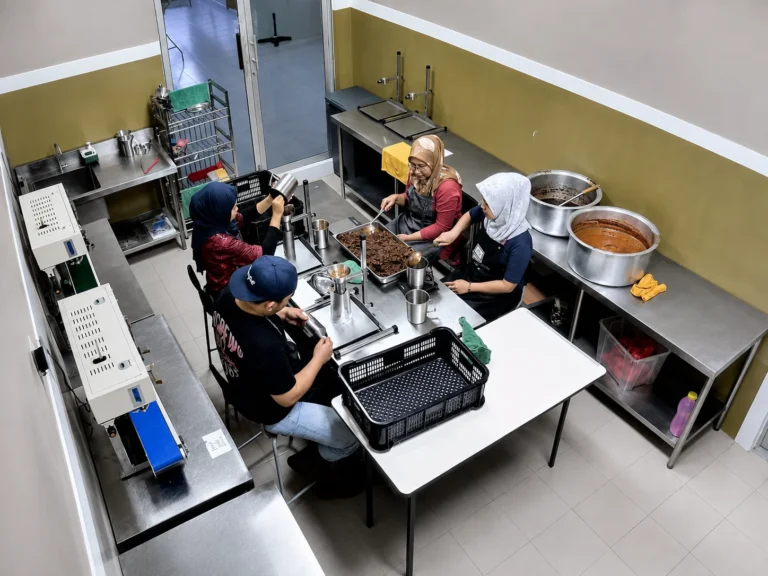
The filling stage at the DapoGo factory, Melaka Halal Hub — this combination of product, fill and pack is what gets tested.
No authority issues a shelf life for your retort product. You set the date and you hold the evidence behind it, which comes in two separate parts: a heat process established by qualified people, and a stability study on the finished product that process produced. Malaysia’s Food Regulations 1985 define what the words on the label mean and how they must be printed, not how long your food lasts.
This guide is for a brand owner whose buyer has started asking questions — a distributor’s spec sheet, a supermarket listing form, an importer’s due diligence pack all ask the same thing: the basis of the date on your pouch. DapoGo fills retort pouches for other brands at its own Melaka Halal Hub factory; the field is explained in our guide to halal OEM and co-packing, the service in DapoGo’s OEM page, and the stages in our OEM process guide. Terms below are defined in our retort food glossary.
Key takeaways
- Regulation 14(2)(a) of the Food Regulations 1985 defines an expiry date without naming any period for any product.
- Date marking is only compulsory for the foods in the Fifth Schedule, headed “FOOD REQUIRING DATE MARKING”. Which entry your product falls under is the Ministry of Health’s call, not your factory’s.
- Two separate bodies of evidence, in order: the heat process is established first, then the stability study runs on product made by that process.
- The US FDA defines a low-acid food by measurement — pH above 4.6 and water activity above 0.85 — which is why a co-packer measures your product before choosing a process.
- DapoGo’s OEM rate card states the lab test is not in the quoted price. The brand owner pays for it and keeps the file.
On this page11 sections
Who decides your product’s expiry date?
The expiry date on your pouch is the brand owner’s decision, not a figure issued by a regulator. The Food Regulations 1985 — made under section 34 of the Food Act 1983 and enforced by the Food Safety and Quality Division of Malaysia’s Ministry of Health (KKM) — tell you what the date means and how it must be printed. They name no period for any product.
“expiry date”, in relation to a package of food, means the date after which the food, when kept in accordance with any storage conditions set out in the label of such food, may not retain the quality attributes normally expected by a consumer
— Regulation 14(2)(a), Food Regulations 1985 (Malaysia), KKM consolidation updated until August 2026
The date is measured against the quality attributes a consumer expects, not safety alone — which is why a buyer can reject a shipment that is perfectly safe but no longer tastes like the sample. BEST BEFORE is the date until which the food “will retain any specific qualities for which tacit or express claim has been made”. And Regulation 14(9)(b) prohibits any person from “import, prepare for sale or sell any package of food which had expired” — all three verbs, so a warehouse of out-of-date finished stock is caught as surely as a sale.
Working out a shelf life for a first product? Send us the product type and the shelf life you are aiming at, and we will set out which part the factory handles and which part you book yourself: WhatsApp DapoGo on 011-5501 3391.
Does your pouch need a date at all?
Not every food does. Regulation 14(4) applies only to “the foods specified in the Fifth Schedule” — a list headed FOOD REQUIRING DATE MARKING. Two of its entries sit closest to a retort maker: “Sauce”, and “Meat product in non-hermetically sealed containers”.
Read that second entry carefully: it names containers that are not hermetically sealed, and a retort pouch is hermetically sealed by definition. Do not draw your own conclusion from that gap — which entry a product falls under is KKM’s determination, not yours and not your co-packer’s. KKM runs a label check, Semakan Label Makanan, at RM250.00 per application on a 15-day charter, and its answer is the one that counts. One thing does not change: the moment you print a date, Regulation 14 governs it.
The two kinds of evidence, and why the order matters
Shelf-life evidence for a retort product comes in two separate parts, and most first-time brand owners only know about the second. The first is the heat process; the second is a stability study on finished product. The second means nothing without the first, because it only measures what came out of that process.
Which heat process you need is decided by measurement, not by what the dish is called. The US regulator defines a low-acid food as one “with a finished equilibrium pH greater than 4.6 and a water activity (aw) greater than 0.85”, with tomatoes and tomato products below pH 4.7 carved out — which is why a co-packer measures your product before choosing a process rather than judging it from the recipe. The process selected is called a scheduled process. The US federal rule 21 CFR 113 — which has no force in Malaysia, and is quoted here for what it defines — puts it this way:
“Scheduled processes for low-acid foods shall be established by qualified persons having expert knowledge of thermal processing requirements for low-acid foods in hermetically sealed containers and having adequate facilities for making such determinations.”
— US Food and Drug Administration, 21 CFR 113.83
The same text names the work: “microbial thermal death time data, process calculations based on product heat penetration data, and inoculated packs”. A heat penetration study is the part a founder sees — measuring how long heat takes to reach the slowest-heating point inside the pouch. Where incubation tests confirm the process, they must include “containers from test trials and from actual commercial production runs”, and the critical factors “shall be measured and recorded on the processing record”, so the batch records are part of the evidence an importer may ask to see.
What the factory must record about your pouch seal
The seal is where a retort shelf life most often fails, and it is monitored separately from the laboratory study. A hermetically sealed container is defined as one designed “to be secure against the entry of microorganisms” so the contents stay commercially sterile after processing. A seal that leaks in month eight makes the product on the shelf something other than the product you tested.
So the rules require that “regular observations shall be maintained during production runs for gross closure defects”, with every defect recorded and corrective action taken, and a qualified container closure inspection person must visually examine “the closure of any other type of container being used” at intervals frequent enough to ensure proper closure. Ask your co-packer whether those records exist for your batch — they belong in the file a buyer will ask for.
What shelf-life testing actually measures
A shelf-life study monitors your finished product across the period you intend to claim, retesting at set intervals. The Malaysian laboratory ALS Malaysia puts the purpose plainly: “Shelf-life verification is to confirm that the food has not deteriorated in quality or spoiled within the reported expiry date.” The word reported is the point — you report the number, the study stands behind it.
| Test group | Examples ALS Malaysia lists | What it tells a buyer |
|---|---|---|
| Microbiological | Total bacteria count, total yeast & mould count, Salmonella sp., Escherichia coli | Whether the pouch stayed commercially sterile across the period |
| Physical and chemical | Moisture, pH, water activity, physical appearance, peroxide value, free fatty acids | Whether the oil has gone rancid and the texture or colour has moved |
ALS Malaysia states that stability data across the shelf life “shall be available as a verification record”. That file is what a corporate buyer or auditor asks for, so book the work in your own company’s name.
Accelerated or real-time — which one can you use?
Retort products create an obvious timing problem: a 24-month claim takes 24 months to observe in real time, and no new brand can wait that long before selling. The route laboratories offer is accelerated ageing. ALS Malaysia provides “accelerated aging at 40ºC, 75% RH for product with a longer shelf-life (12 -36 months)”, and states the reason directly: “to increase the rate of deterioration and shorten the lead time of study to less than 12 months”.
That second sentence also sets the limit. Accelerated testing shortens the study; it does not replace watching product held under normal storage. Our recommendation is to run both — accelerated work gives the number you launch with, and a real-time study continues on retained stock after the product is on sale.
Who pays for the test, and in what order?
The brand owner pays. DapoGo’s OEM rate card lists it openly — “Excluded unless stated: artwork, lab test, nutrition facts, barcode, halal application.” The lab test is not part of the OEM fee, because the number on the label is your claim, not the factory’s. It is also the line most often missed when a founder compares factory quotes.
- Freeze the recipe and the pack. DapoGo’s policy allows a maximum of three recipe revisions; a change of ingredient or container after that is a different product for testing purposes.
- Run the pilot batch. DapoGo’s pilot MOQ is 300 to 500 pouches per SKU, with full production from 1,000 pouches per SKU. The pilot is where your test samples come from, because it is made by the same process as production — what happens on the day is in our retort pilot batch guide.
- Send samples to the laboratory. Ask which tests sit inside its accreditation scope before you book, and retain some pouches for the real-time study.
- Print the date once you have results. DapoGo’s stated stage timings — consultation 1 to 2 days, sample and taste testing 2 weeks, production 1 to 2 months — do not include the laboratory study, so plan artwork around the lab.
Once you have the number: what the pack must show
One trap is worth knowing before artwork: under Regulation 10 a pouch made in Malaysia must carry its label words in Bahasa Malaysia, so the Malay date forms of Regulation 14(5) lead — TARIKH AKHIR / TH AKHIR, GUNA SEBELUM / GUNA SBL, MAKAN SEBELUM / MAKAN SBL, and BAIK SEBELUM / BAIK SBL — with the familiar English forms available only for imported food or as an added translation. And a batch code is not a date: “the marking of date in code form for lot identification does not constitute date marking”. Everything else your pouch must show is in our packaged food labelling guide.
FAQ: proving a retort product’s shelf life
Can I use 24 months because other retort products use it?
No. DapoGo publishes a 24-month ambient shelf life for its own ready-to-eat pouches, and that is DapoGo’s claim for DapoGo’s product. Your product measures differently on pH and water activity and goes through its own heat process, so the figure does not transfer.
If I change the recipe or pack size after testing, do I retest?
Yes — treat it as a new product. The heat process is established for one combination of product, fill and container, and its critical factors are recorded for that combination. Change the fill, an ingredient or the container, and the evidence you hold describes something you no longer sell.
Our product is a sambal paste in a glass jar, not a pouch. Is it different?
Different container, same logic. What decides the kind of heat process is the product’s pH and water activity, not the shape of the container; what has to be proven about the container is that it stays sealed after processing. DapoGo fills both retort pouches and glass jars for sambal.
Will an overseas importer accept a Malaysian laboratory’s report?
Ask the importer before you book — the answer is theirs, and it varies by market and buyer. What travels in every case is the underlying file: which tests were run, at what intervals, on product from which batch, against which storage conditions.
Next step for your product
Send us the product type, the pack you have in mind and the shelf life you are aiming at. We will come back with what has to be frozen first, when a pilot batch can become your test samples, and which part of establishing the heat process sits with the factory and which you commission yourself: WhatsApp DapoGo on 011-5501 3391. If your question is the buyer’s one — how long a retort pouch lasts and why — our guide to how long retort food lasts answers it.
Sources
- Food Regulations 1985 (Malaysia), KKM consolidated text “Updated until August 2026” — Regulation 10, Regulation 14 and the Fifth Schedule, Bahasa Malaysia and English texts (accessed 18 October 2026)
- Food Safety and Quality Division, Ministry of Health Malaysia: Semakan Label Makanan (accessed 18 October 2026)
- US FDA, 21 CFR Part 113 — Thermally Processed Low-Acid Foods Packaged in Hermetically Sealed Containers (accessed 18 October 2026)
- ALS Malaysia: Shelf-Life Studies (accessed 18 October 2026)
Want this made for your brand?
WhatsApp 011-5501 3391