
Meals On the Go
Halal Food for Muslim Tour Groups: South Korea & Taiwan
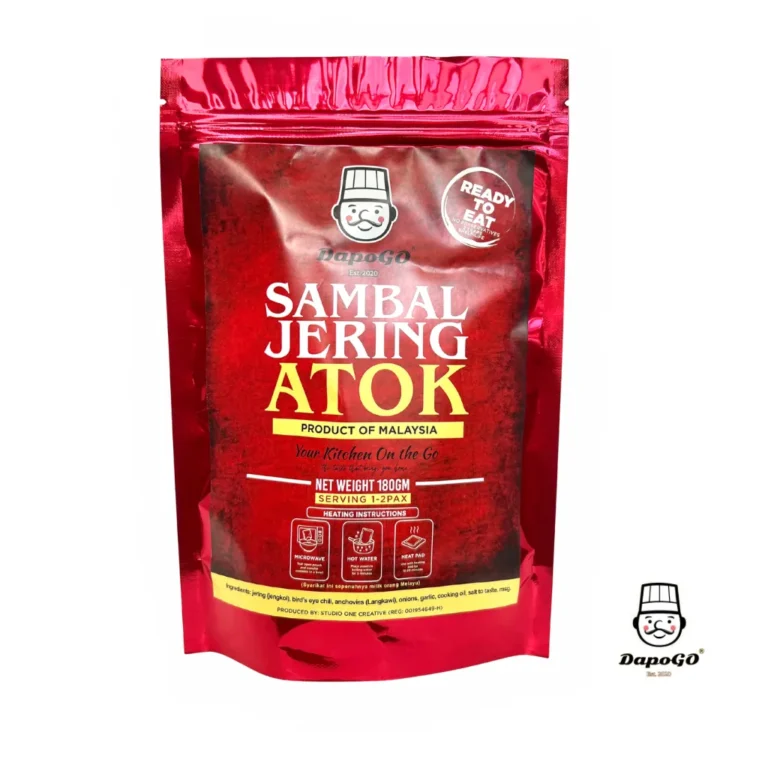
Sambal Jering Atok: its ingredient list has no livestock meat, eggs or dairy
Tour operators can carry Malaysian halal ready-to-eat food for groups travelling to South Korea and Taiwan, but not meat products. Taiwan tells arrivals to bring no meat-containing food or other animal products, and South Korea requires a departure-country quarantine certificate for livestock products. Products with no animal ingredient at all are the simplest option for both.
This guide is for tour operators, DMCs and group organisers planning Muslim itineraries through Seoul, Busan, Taipei or Kaohsiung. DapoGo cooks its ready-to-eat dishes in retort pouches at its own plant in the Melaka Halal Hub and publishes a full ingredient list for every product on its product pages — the list an officer at the counter will read. It sits alongside our guide to when ready-to-eat meals earn their place; for other destinations see our guide to Europe, the UK and Japan and our umrah travel guide.
The short version
- Taiwan tells arrivals to bring no meat-containing foods, other animal products, or meals provided on flights. The notice is dated 27 August 2026, issued to prevent African swine fever.
- Taipei Customs lists dried or marinated aquatic products, and items compliant with quarantine regulations, as exceptions.
- South Korea requires processed meat to be declared, with a quarantine certificate from the country of departure.
- For seafood, Korea states that cooked or dried products are not subject to inspection.
- Five DapoGo products publish an ingredient list with no meat, eggs or dairy: Sotong Kicap Berempah, Sambal Jering Atok, Chili Oil, Nasi Putih Basmathi, Sambal Kicap Johor.
On this page8 sections
Why do Muslim groups in Korea and Taiwan need to carry food?
Muslim tour groups carry ready-to-eat food because part of any itinerary falls outside the booked halal restaurant list. Long coach days between cities and late-night arrivals are two slots that easily escape the plan.
The market behind this is growing. In the foreword to the Mastercard-CrescentRating Global Muslim Travel Index 2026, Fazal Bahardeen, Founder and CEO of CrescentRating, writes: “In 2025, the market demonstrated exceptional resilience, with actual international Muslim arrivals reaching 196 million, a solid 11.3% year-on-year increase”, on a path to 262 million by 2030.
Both destinations are already on the Muslim travel map. The same report places Taiwan third among non-OIC destinations alongside the United Kingdom on a score of 59, with over 450 local hospitality and dining establishments in the island’s Muslim-friendly ecosystem as of 2026; South Korea sits tenth on 52, up five places. Carried food is a gap-filler, not a substitute for a halal restaurant programme.
Planning a Korea or Taiwan departure? Send us the destination, the dates and the headcount and we will come back with a product mix: WhatsApp DapoGo on 011-5501 3391.
Can you bring Malaysian ready-to-eat food into Korea and Taiwan?
Malaysian ready-to-eat food can be carried into Korea and Taiwan, but the two countries restrict meat differently and treat seafood differently too. One buying list cannot serve both destinations without being checked against each.
| Destination | Meat and livestock products | Seafood | Official source |
|---|---|---|---|
| Taiwan | Official notice: bring no meat-containing foods, other animal products, or meals provided on flights | The Taipei Customs exception is dried or marinated aquatic products. Cooked, sauced products are not named | National Immigration Agency · Taipei Customs |
| South Korea | Processed meat (ham, sausage, jerky, canned meat) must be declared, with a quarantine certificate issued by the country of departure | Cooked or dried marine products are not inspected. Live, chilled or frozen abalone, oysters and shrimp must be declared | Incheon: Animal & Plant Quarantine · Incheon: Seafood Quarantine |
This table was checked against those official pages on 17 October 2026. One distinction is easy to miss: Korea refers to seafood that is cooked or dried, while Taiwan’s listed exception is aquatic products that are dried or marinated. A cooked, sauced pouch is not named on the Taiwanese page, so confirm it with Taiwan customs or quarantine before it goes on a buying list.
Two things those pages do not answer. We cite the Incheon pages for animal and seafood quarantine; Korea’s plant quarantine rules for ingredients such as rice, chilli and legumes were not checked here. And Taipei Customs sets a 1 kg limit on milled rice, but does not say whether cooked rice in a sealed pack counts towards it.
A halal certification mark also buys no exemption at a quarantine counter. The Taiwanese notice was issued to prevent African swine fever, and none of these pages lists an exemption for halal food. What a halal label covers is set out in is ready-to-eat food halal.
Which DapoGo products suit a Korea or Taiwan itinerary?
Five DapoGo products publish an ingredient list with no meat, eggs or dairy and no flavouring whose contents are unstated. Two contain no animal ingredient at all, so the rules above do not reach them; the other three are seafood-based and need checking per destination.
| Product | What is in it | Korea | Taiwan |
|---|---|---|---|
| Nasi Putih Basmathi (aluminium pouch) | Basmati rice and filtered water | No animal ingredient | No animal ingredient. Check the rice limit above |
| Sambal Kicap Johor (glass bottle) | Chilli, garlic, shallots, soy, calamansi | No animal ingredient | No animal ingredient |
| Sotong Kicap Berempah | Squid, soy sauces, spices | A cooked marine product, not inspected | Cooked and sauced, not dried or marinated. Confirm first |
| Sambal Jering Atok (aluminium pouch) | Kampung chilli, jering, anchovies | Anchovy, not a listed livestock product | Confirm first |
| Chili Oil | Dried chilli, oils, dried shrimp | Dried shrimp: a dried marine product | Contains dried shrimp. Confirm first |
Two other groups are off that list. Products containing meat or poultry, such as Nasi Briyani Ayam Batu Pahat, are not carried to Taiwan, and for Korea would need a departure-country quarantine certificate. And six of our seafood products list a permitted flavouring without naming its contents — we do not recommend those until DapoGo confirms it carries no chicken or beef stock.
For quantities, the product pages give serving guidance: Sotong Kicap Berempah serves 2–3 people per pack and Nasi Putih Basmathi 1–2. For a single meal for 20 people, that is 10 to 20 rice packs and 7 to 10 dish packs. DapoGo’s product pages state a two-year shelf life at room temperature, so an order can be placed weeks ahead with no cold chain — see what is retort processing.
How much can one group bring in?
Taiwan applies quantity thresholds that matter to anyone buying in bulk. Taipei Customs sets a combined 6 kg limit for general agricultural products, a 1 kg limit for milled rice, and states that food requires TFDA inspection when one kind exceeds 6 kg or is worth more than USD 1,000. The page does not explain what that inspection involves.
So split a large order across participants’ bags rather than consolidating it in the tour leader’s luggage. A bulk order of a single product can pass that 6 kg threshold easily, while the same quantity spread across travellers does not accumulate on one person. The Taipei Customs page does not say whether the limit is counted per traveller. For Korea the binding constraint is declaration, not weight: declare any livestock product, and keep each product in its original packaging.
A pre-departure checklist for operators
These five steps turn planning into an afternoon’s work, and the order matters: the count comes from the itinerary, not the catalogue.
- List the itinerary meals with no halal restaurant booked. That number, not the number of days, is your pack count.
- Remove every meat and poultry product from the Taiwan list, and set them aside for a Korea certificate check.
- Check the published ingredient list for each remaining product and carry a printed copy. A copy in the destination language helps further, though the official pages do not require it.
- Split the order across participants’ bags so no bag carries a bulk quantity of one product.
- Brief the group: if in doubt at the counter, declare it.
FAQ: carrying halal food to Korea and Taiwan
Can you bring rendang or other meat dishes into Korea and Taiwan?
Not into Taiwan. The official notice tells arrivals to bring no meat-containing food, and names no exemption for food that has been cooked or sealed. For Korea, processed meat must be declared with a quarantine certificate from the country of departure; the Incheon page does not explain how a traveller would obtain one for a retail food pack.
What should a traveller do if they find a meat product in their bag on arrival?
Do not hide it. Taiwan’s notice tells travellers to “dispose of them in designated disposal bins before entering Taiwan” or “declare them for disposal before passing through customs”. In Korea, livestock products are declared on the customs form.
What do the official pages say about fines, and what do those fines actually cover?
The two fines mentioned have different scopes, and neither is about cooked seafood packs. In Taiwan, illegally bringing in pork from an African swine fever affected area “will be fined NT$200,000 for a first offense and NT$1 million for a second offense”. In Korea, fines are imposed for bringing livestock products in without quarantine, and failing to declare aquatic animals may draw up to KRW 1 million.
How are the packs heated on tour?
Follow the product page method. DapoGo states that Sotong Kicap Berempah is heated in boiling water for two minutes, and that Nasi Putih Basmathi is heated unopened in boiling water. Chili Oil and Sambal Kicap Johor carry no heating instruction, and Sambal Kicap Johor needs chilling once the bottle is opened.
Start planning your group’s meals
Mark the meals no halal restaurant covers, and the pack count follows. If you build Muslim group tours to South Korea or Taiwan, send us the destination, dates and headcount and we will come back with a product mix and the ingredient lists to take to the counter: WhatsApp DapoGo on 011-5501 3391.
Sources
- Taiwan National Immigration Agency: notice on meat-containing foods in baggage, 27 August 2026 (accessed 17 October 2026)
- Taipei Customs: Items Subject to Other Regulations (accessed 17 October 2026)
- Incheon International Airport: Animal and Plant Quarantine (accessed 17 October 2026)
- Incheon International Airport: Seafood Quarantine (accessed 17 October 2026)
- Mastercard-CrescentRating: Global Muslim Travel Index 2026 (accessed 17 October 2026)
Want to try DapoGo?
WhatsApp 011-5501 3391