
Ready-to-Eat Basics
How DapoGo Works: Retort Ready-to-Eat Food, Explained

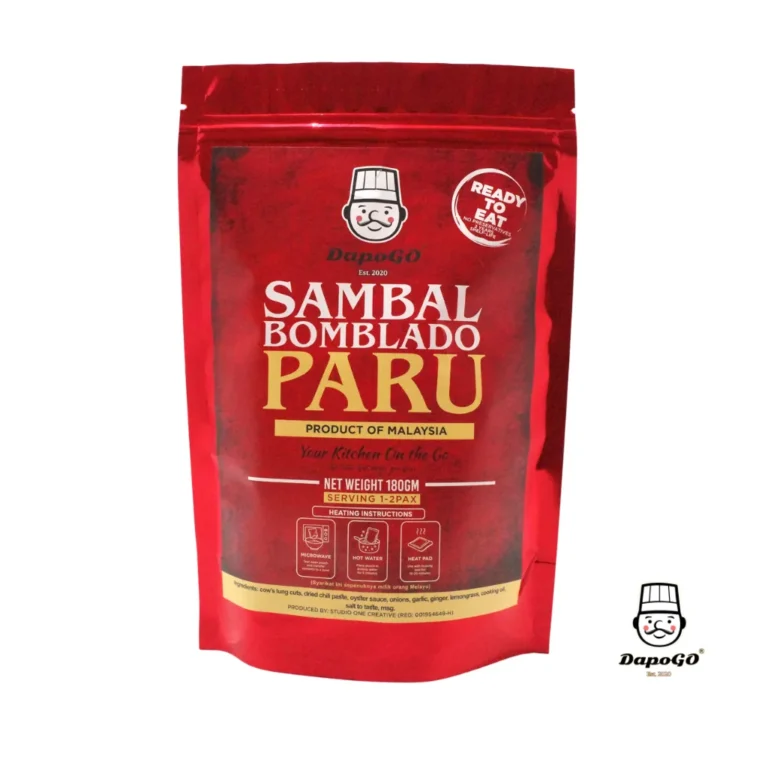
We cook traditional Malaysian dishes in our own kitchen at the Melaka Halal Hub, then seal and sterilise them inside retort pouches — a high-heat process that lets food keep for up to 24 months at room temperature, with no refrigeration. That is our published specification for every DapoGo product. To eat, you heat the pouch for 3 to 5 minutes and serve.
This page answers the questions people ask before their first order: what retort food actually is, why it keeps so long, whether it is safe and halal, and how to heat it properly.
On this page8 sections
What is retort food?
Retort food is cooked and sterilised inside its sealed pouch. Ordinary packaged food is cooked first and packed afterwards; retort reverses that. The filled, sealed pouch goes through high temperature and pressure until the microorganisms that spoil food are destroyed.
The result is fully cooked food in an airtight pouch that needs no cold chain. It is the same technology used for military rations and airline meals — we use it for rendang, sambal, gulai and rice sets. For a deeper look at the process itself, read What is retort processing?
Why does it keep without a fridge?
Food spoils because of microorganisms — bacteria, moulds, yeasts. Retort processing destroys them with heat, and the sealed pouch stops new ones getting in. Until the pouch is opened or damaged, there is nothing inside that can spoil the food.
That means the shelf life comes from the process, not from preservatives. DapoGo pouches keep for up to 24 months at ambient temperature under our published spec — on a kitchen shelf, in a cupboard, or in your luggage. The full detail is in How long does retort food really last?
Is it safe, and is it halal?
On food safety: retort sterilisation is one of the most established preservation methods in the food industry — the contents of an unopened pouch are sterile. On halal: our factory operates inside the Melaka Halal Hub, an industrial park dedicated to halal food production, and we state that all our products are 100% halal.
We would rather you ask than wonder — message us on WhatsApp at +60 11-5501 3391 for product certification details. To understand what Malaysian halal certification covers and how to verify it yourself, read Is ready-to-eat food halal?
How do you heat it?
The simplest way: submerge the unopened pouch in hot water for 3 to 5 minutes. No special pot, no stove needed — a hotel-room kettle does the job, which is why our customers take these pouches on umrah and overseas trips. You can also empty the pouch onto a plate and microwave it, or warm it briefly in a pan.
For situations with no fire and no power — mid-journey, at a campsite — there is the DapoGo Heat Pad, which heats a pouch with no power source at all. The full guide, including the common mistakes, is at How retort food keeps — and how to heat it right.
Where did DapoGo come from?
Our ready-to-eat business started in October 2020 under Studio One Creative. DAPOGO FOOD INDUSTRIES SDN. BHD. was registered in January 2025, and in June 2026 we moved into our own factory at the Melaka Halal Hub — Plot 31 & 32, Jalan EP Serkam 9, Serkam, Melaka.
Today the catalogue spans 54 products across 7 categories — from old-school anchovy sambal to Batu Pahat mutton briyani — with more than 5,170 customers to date. The same kitchen now offers halal OEM & co-packing services for founders who want their own food brand made for them. Outside Malaysia, our products are also available through Halal Street UK.
Does the taste and texture suffer?
A fair question, and the honest answer is: high-heat processing affects different foods differently. Gravy-based, coconut-rich dishes — rendang, gulai, asam pedas, sambal — actually suit retort well, because they are the kind of cooking that is slow-cooked over fire anyway; some deepen in flavour as the spices settle in the pouch. Rice texture does come out slightly different from freshly cooked rice, and we walk through that set by set, without varnish, in Rice meals in a pouch.
That is why our catalogue leans towards braised and spiced dishes — we chose to make what this format does well, rather than force every kind of food into a pouch. We apply the same principle when assessing OEM customers’ products.
What happens inside our factory?
Every pouch follows the same path: ingredients are prepared and cooked to our recipe, the food is filled into laminated pouches, each pouch is heat-sealed, and then the sealed pouch goes through the retort chamber — held at high temperature and pressure for a set time, cooled, dried and labelled. From there it can be stored at room temperature.
All of it happens in one place: our factory in the Melaka Halal Hub. No third-party contracting for DapoGo products — the kitchen that cooks your food is the one we control ourselves. That is also why we are confident offering the same facility to other founders through our co-packing service.
Related questions
- How long does retort food really last? — storage life, storage conditions, and what shortens them.
- Is ready-to-eat food halal? — the three layers of halal and how to check them.
- No preservatives? — why the retort process needs none.
- The DapoGo dish guide — choosing pouches by taste and heat level.
- FAQ — short answers to the most common questions.
Want to try DapoGo?
WhatsApp 011-5501 3391