OEM & Co-packing
Private Label or Your Own Recipe? Choosing a Malaysian Co-Packer
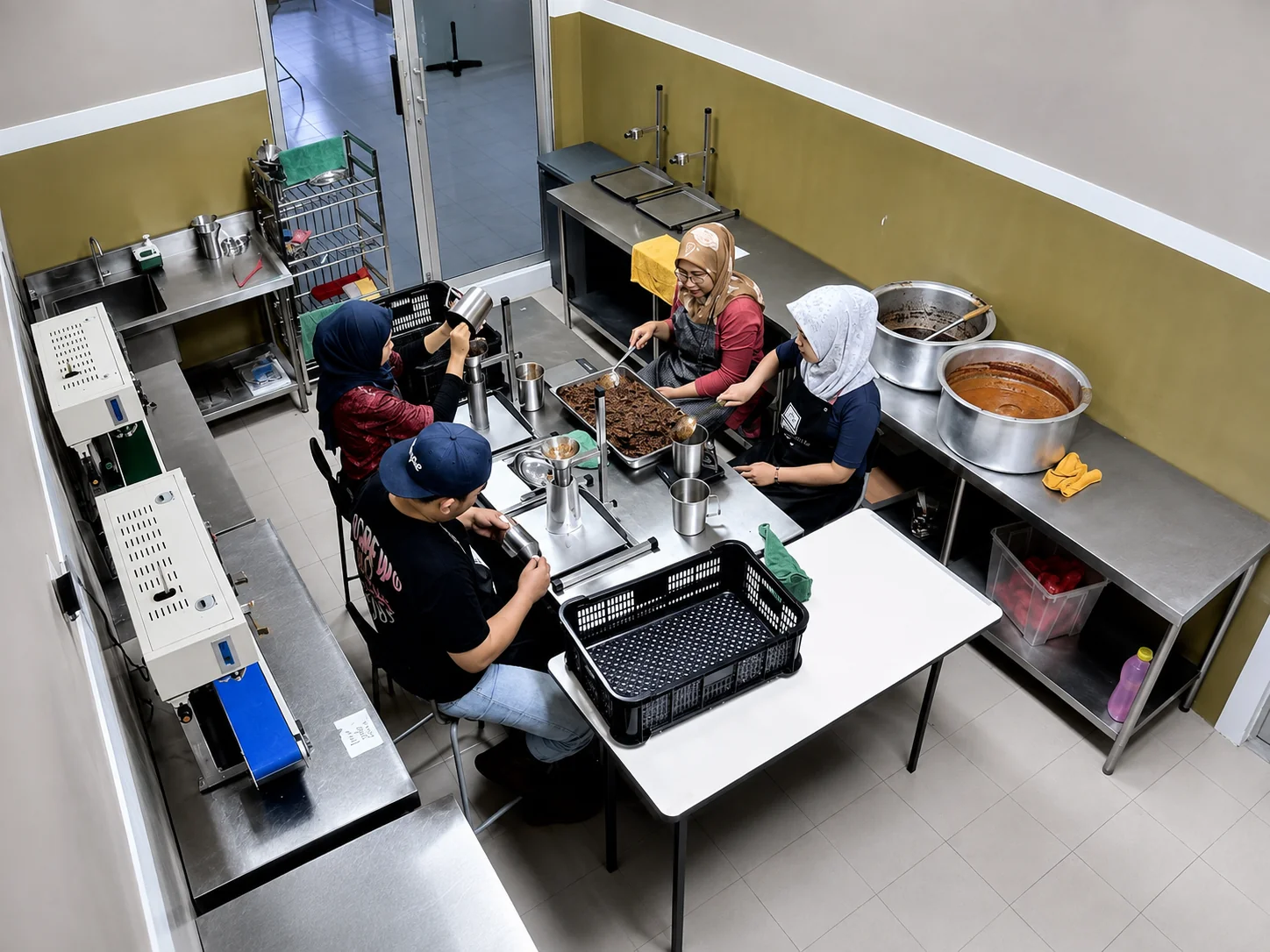
The DapoGo kitchen at Melaka Halal Hub: the filling stage, before the pouches are sealed.
One thing separates them: who owns the recipe when the run is finished. Private label means you sell the factory’s existing formula under your name, and the factory keeps it. Your own recipe means the formula is yours. That choice sets your start-up cost, whether anyone else can sell the same product, and who applies for the halal certificate on the finished pouch.
This page is part of the DapoGo guide to halal OEM and co-packing, written by the DapoGo team, a retort food maker at our own plant in the Melaka Halal Hub, Serkam. In the enquiries we get, founders reach this fork before they ask about price, usually with the wrong vocabulary: American sources say "co-packing" and "private label", but in Malaysia both routes are advertised as OEM.
At a glance
- Private label = the factory’s recipe, your name. Own recipe = your formula, made to order.
- A factory’s contract-manufacturing halal certificate is not a halal certificate for your product.
- Malaysian label law names the manufacturer, the packer, or the owner of the rights of manufacture.
- On DapoGo’s published rates the own-recipe route starts at least RM2,000 higher.
- The halal file expects a written contract between the factory and the brand owner.
Private label or co-packing? The words mean different things here
The American terms are precise. PacMoore puts it plainly: under a co-packing agreement the customer owns the rights to a proprietary formulation even though the manufacturer makes the product, and the manufacturer usually signs a non-disclosure agreement. Under private labelling the manufacturer makes its own formulation under the customer’s label and keeps the rights.
Malaysian factory pages rarely draw that line: the paste maker Kantan Food sells private label as the quick way into the market, never saying what you give up.
Who owns the recipe when the run is finished?
Under private label the factory keeps the formula: when the run ends the recipe stays behind. Under your own recipe the formula is yours, and if the contract says so it travels with you.
| What changes | Private label | Your own recipe |
|---|---|---|
| Formula owner | The factory | You |
| Speed to first sale | Fastest; development is skipped | Slower; sample and tasting stage |
| Exclusivity | Another brand may sell a near-identical product | The product exists for your brand only |
| If you change factory | The recipe stays behind | The recipe travels, if the contract says so |
| Best suited to | Testing demand, gifting, a menu extension | A family recipe, a taste that is the brand |
Our guide to the food brand without a factory covers what to prepare.
Does the factory’s halal certificate cover your product?
No, and it is the most expensive misunderstanding here. JAKIM’s Manual Prosedur Pensijilan Halal Malaysia (Domestik) 2020 defines the contract-manufacturing or OEM scheme as certification for a company supplying manufacturing services to another company under written contract. The scheme certifies the service.
Paragraph 18(8)(b) states that the scheme "tidak boleh digunakan sebagai perakuan halal ke atas produk yang dikilangkan" — it is not halal certification for the product manufactured — and that every product wanting the halal logo must apply for its own certificate. Paragraph 41(6) adds that an OEM-scheme holder must not print, affix or display the Halal Malaysia logo on a product it manufactures unless that product holds its own certificate.
The duty runs both ways: an applicant must also check the factory it appoints already holds that certificate. You can check that yourself, free. On the Halal Malaysia portal the verification categories list "Pengilangan Kontrak / Original Equipment Manufacturing(OEM)" separately from "Produk Makanan / Minuman". The factory sits in one; your product will sit in the other.
Premises certification is a third thing. MeSTI is the Ministry of Health scheme introduced because the full food-safety programme was hard for small premises to obtain, and it belongs to the premises, not the brand owner. Which certificates the law requires is in MeSTI, halal and HACCP; the terms are in our retort food glossary.
Whose name goes on the label under Malaysian law?
Malaysia’s Food Regulations 1985 require the label of locally made or packed food to carry "the name and business address of the manufacturer or packer, or the owner of the rights of manufacture or packing or the agent of any of them". Three possibilities, not one.
That third phrase is why contract wording matters before artwork is printed: ask which of the three describes you. A buyer in Singapore or the UK reads that line and draws conclusions about who makes your food.
What does each route cost to start?
On DapoGo’s published rates the own-recipe route starts at least RM2,000 above private label: from RM1,500 for Private Label against from RM3,500 for a Custom R&D Retort Sample. Both are "from" figures, so RM2,000 is the minimum gap at quotation, not the final difference.
| Stage | DapoGo published rate |
|---|---|
| Consultation | RM250 |
| Private Label | from RM1,500 |
| Custom R&D Retort Sample | from RM3,500 |
| Complex Product Development | from RM5,000 |
| Pilot batch | 300–500 pouches |
| Full production | from 1,000 pouches |
| Payment | 70% deposit, 30% before delivery |
The same card sets a 300–500 pouch pilot and 1,000-pouch production. Timing runs by stage, never one promised total: consultation one to two days, sample and tasting about two weeks, production one to two months. The full cost picture is in halal food OEM in Malaysia, and the sequence in the five-step OEM process.
Which route fits your brand?
Three conditions decide it. If you are still testing whether anyone buys, private label costs least to find out. If the taste is the reason customers come to you, the recipe has to be yours. If a near-identical product under someone else’s brand would damage you, only your own recipe keeps it exclusive.
- You are testing demand. A pilot of 300–500 pouches shows whether people buy twice.
- The taste is the brand. No catalogue formula substitutes for a recipe customers come for.
- You are planning to export. Malaysia’s halal exports reached RM68.52bil in 2025, 4.3% of total exports, according to The Star, and minimums abroad are counted differently: the offshore supplier Yohu quotes its minimum in cartons, from 2,000 — a different class of commitment from a minimum counted in pouches.
The sterilisation step is the same either way: what is retort processing.
What to put in writing before you sign
The halal manual already assumes the paperwork exists: a written contract between the factory and the customer company or brand owner must be prepared. Use it to settle these five things before any deposit changes hands.
- Who owns the recipe afterwards, and whether it can be taken to another factory.
- Whether a non-disclosure agreement binds the factory, and whether the same formula may be sold to anyone else.
- How many recipe revisions are included, and what happens after them. DapoGo’s own policy is a maximum of three.
- Which halal scheme the factory holds, in writing rather than in conversation.
- Who applies for the product’s halal certificate, and who pays for artwork, nutrition facts and barcodes.
"Pemilik perniagaan sebenarnya bukan sahaja memiliki perniagaan tersebut, tetapi mereka mesti memastikan segala proses dari awal hingga akhir memenuhi piawaian."
Azryana Aqasha Mohd Faizal, Executive Director of Flavaris (Malaysia) Sdn Bhd, quoted in Sinar Harian. In English: a brand owner does not merely own the business, they must make sure every process from start to finish meets the standard.
Our own side of it: DapoGo’s halal OEM and co-packing services.
Quick questions
If the factory is halal certified, is my product automatically certified too?
No. The Malaysian halal certification manual states that the OEM scheme cannot be used as halal certification for the product manufactured: every product that wants the halal logo must apply for its own certificate.
What is the smallest quantity I can start with?
On DapoGo’s published rates a pilot batch is 300–500 pouches and full production starts from 1,000 pouches per SKU. The pilot exists to test real sales, not to fill a warehouse.
Can I start with private label and move to my own recipe later?
Yes, and many brands do. But the private-label formula stays with the factory, so treat the move as a new product carrying development costs from RM3,500, not as an amendment to an existing one.
What is the next step?
If you already know the taste you want to sell, start with one conversation about the recipe, the quantity and the pack format — that is what decides which route you are on. Other questions are answered in the DapoGo FAQ. To ask directly, WhatsApp 011-5501 3391.
Sources
- JAKIM: Halal certification procedure manual 2020
- Food Regulations 1985, Regulation 11 (copy consolidated to January 2014)
- Halal Malaysia Portal: verification categories
- Ministry of Health: MeSTI scheme
- The Star: Matrade projects steady halal export growth
- Sinar Harian: Tanggungjawab pemilik perniagaan
- PacMoore: Co-Packing vs. Private Labeling
- Kantan Food: Pes Masakan Jenama Sendiri
- Yohu: Private Label & OEM