
OEM & Co-packing
Packaged Food Labelling in Malaysia: What Your Pouch Must Show
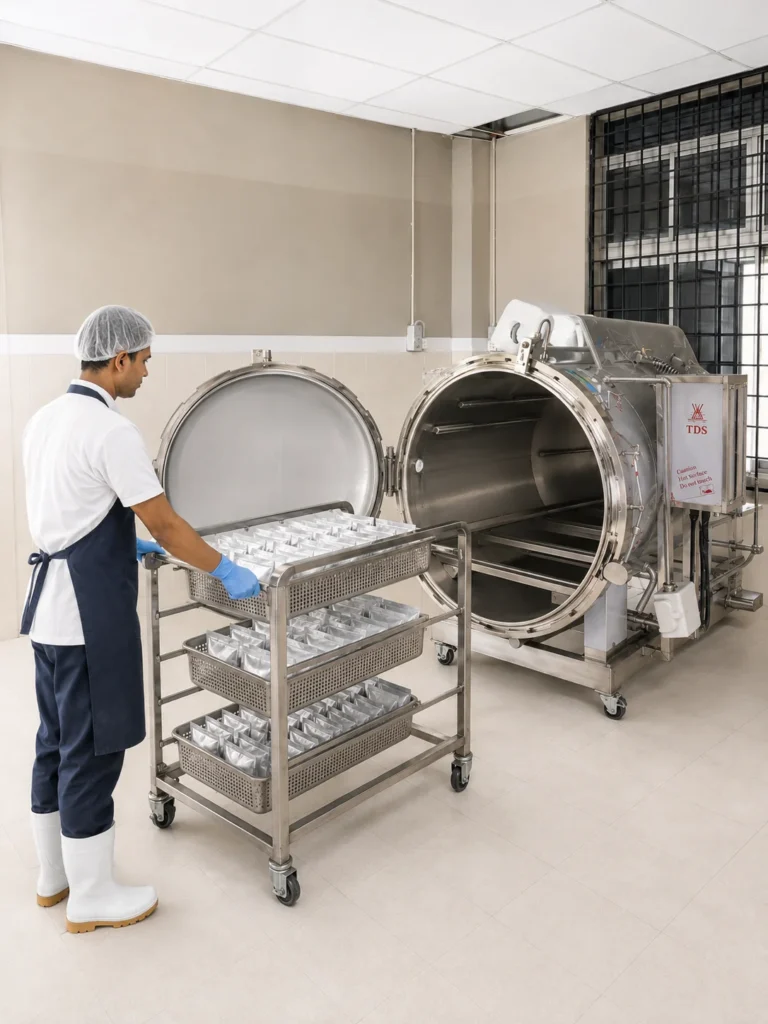
Pouches on a trolley before they go into the retort, at the DapoGo factory, Melaka Halal Hub.
Food made or packed in Malaysia must be labelled in Bahasa Malaysia, and the label must at least show the food’s proper name, the ingredients in descending order of weight, any allergens, the minimum net weight, and the name and business address of the manufacturer, the packer or the owner of the rights of manufacture or packing. Depending on the recipe you also need a “contains beef” statement, the percentage of any ingredient you highlight, a date in a prescribed form and a nutrition panel. All of it comes from the Food Regulations 1985.
This page belongs to our halal OEM and co-packing guide, written by the DapoGo team from our own retort kitchen at the Melaka Halal Hub in Serkam, Melaka. Our reference is the Ministry of Health’s (KKM’s) own consolidated text of the Food Regulations 1985, updated to August 2026. The label is usually the last thing an OEM project gets to, when it should be planned while the recipe can still change. This page explains why.
Key takeaways
- For food made in Malaysia, every required particular must be in Bahasa Malaysia. English can sit beside it as a translation.
- Beef in the recipe? The label needs “MENGANDUNGI DAGING LEMBU” (contains beef) directly under the food’s name, even when the product is halal.
- Prawns and squid count as “fish” in the regulations, so both are declared allergens.
- Required particulars are at least 10 point. The ingredient list, address and nutrition panel may go down to 4 point.
- “Tarikh luput” is not one of the date forms the regulations name for Fifth Schedule foods; the named forms are TARIKH AKHIR, GUNA SEBELUM, MAKAN SEBELUM and BAIK SEBELUM.
- KKM can review a label before you print it: RM250 per application, with a 15-day service charter.
On this page12 sections
What language must a Malaysian food label be in?
Bahasa Malaysia. Regulation 10 says that every word, statement, piece of information or direction the regulations require on the label of food “produced, prepared or packaged in Malaysia” must be in Bahasa Malaysia, and may include a translation in any other language. Imported food can be labelled in Bahasa Malaysia or English.
The rule covers the required particulars. Your brand name is not one of them, so an English brand name is fine. What is not allowed is a label whose required particulars appear only in English. Destination-country rules are a separate question, which we cover in our note on exporting to Singapore and the UK.
What must the label carry, item by item?
Regulation 11(1) lists the particulars every package of food for sale must carry. For a curry, sambal or rice meal in a retort pouch, these are the ones that usually apply:
| Particular | Regulation | What it means for your pouch |
|---|---|---|
| The food’s proper name | 11(1)(a), (aa); 12(2) | A name that does not mislead, with words on the food’s true nature and physical condition. It must stand out from everything else on the label except a trade mark. |
| Ingredient list | 11(1)(e) | In descending order by weight: heaviest first. |
| Allergens | 11(1)(ea) | Five groups, covered below. |
| Ingredient percentage | 11(1)(eb) | If the label emphasises an ingredient in words, pictures or graphics, its percentage by weight or volume goes next to that ingredient’s name. |
| Fats and oils | 11(1)(f) | State that they are present, with the animal or vegetable source, for example palm oil. |
| Additives | 11(1)(g) | The functional class, then the name or INS number. For flavouring, the functional class only. |
| Minimum net weight | 11(1)(i), (ia) | Food packed in liquid also needs a minimum drained weight. |
| Manufacturer, packer or rights owner | 11(1)(j) | Name and business address. A post office box is not enough. |
Look closely at the last row. Regulation 11(1)(j) accepts the name and business address of the manufacturer or packer, or of the owner of the rights of manufacture or packing, or the agent of any of them. For a product sold under your own brand, your company may be able to appear as the rights owner instead of the factory, if your agreement with the factory gives you those rights; confirm it through KKM’s label review. Agree whose name goes on the pack before artwork starts.
Why does a beef rendang need “contains beef” on the pack?
Because regulation 11(1)(c) requires it for any food containing beef or pork, their derivatives, or lard. The form is “CONTAINS” followed by what is present, or other words to that effect; for food made in Malaysia that means the Malay form, “MENGANDUNGI DAGING LEMBU”. Regulation 11(2) fixes its position: immediately below the food’s name. The rule has nothing to do with halal status. A halal beef rendang still needs the statement.
Regulation 155 adds one more for meat products: the common name of the kind of meat must be printed in letters of at least 10 point, and where there are two or more kinds of meat, in descending order of proportion. A dish called simply “daging” (meat) still has to name its meat on the label.
Prawns, squid and soy sauce: which allergens must you declare?
Regulation 11(5) lists five groups of food known to cause hypersensitivity: cereals containing gluten (wheat, rye, barley and oat); nuts and nut products, including peanut and soybean; fish and fish products; milk and milk products, including lactose; and eggs and egg products. Three of these are easy to miss in Malay cooking:
- Prawns and squid are “fish”. Regulation 156 defines fish as including crustaceans, molluscs and other edible aquatic life. Sambal udang, squid in soy sauce and anchovy sambal all carry an allergen.
- Kicap brings soy, and possibly wheat. The soy sauce standard in regulation 340 describes it as made from soya beans and cereal or flour. Check the label of the kicap you cook with, because its ingredients carry into your product.
- Ghee is a milk product. It has its own standard in the milk and milk products part of the regulations (regulations 83 and 105). A briyani cooked with ghee carries a milk allergen.
Which date forms are legal on the pack?
Regulation 14 makes date marking compulsory for the foods listed in the Fifth Schedule, among them sauce, coconut milk, fish balls or fish cakes, biscuits, bread, and meat products in containers that are not hermetically sealed. A sambal may fall under the definition of sauce in regulation 339; that is a question for KKM’s label review, below. For listed foods the date must take one of these forms, followed by the day, month and year, or the month and year:
- TARIKH AKHIR or TH AKHIR (expiry date)
- GUNA SEBELUM or GUNA SBL (use by)
- MAKAN SEBELUM or MAKAN SBL (consume by)
- BAIK SEBELUM or BAIK SBL (best before, the date of minimum durability)
The English text of the regulations gives the same forms in English (EXPIRY DATE, USE BY, CONSUME BY, BEST BEFORE); for food made in Malaysia the Malay form is the required one and the English can sit beside it. Three more conditions apply. The date goes in capital, bold, non-serif letters of at least 6 point. If its validity depends on how the food is stored, the storage direction must be on the label. And a lot code is not a date mark. Where only a month and year are given, the date is taken as the end of that month.
How far ahead that date can be set is for shelf-life testing to decide, not guesswork. How the retort process lets food keep at room temperature is explained in our note on how long retort food lasts.
When is a nutrition panel compulsory?
Regulation 18B requires nutrition labelling for foods under particular standards. The list is long, but the entries closest to retort food are canned meat (regulation 149), canned meat with other food (151), prepared fish (160), canned fish (161), soup (223), sauce (339) and chilli sauce (342). The canned meat and canned fish standards describe food packed in hermetically sealed containers and processed by heat to ensure preservation, which is the same principle as a retort pouch.
If your product falls under one of those standards, the panel must show energy, protein, available carbohydrate, total sugars and fat per 100 g and per serving, plus sodium in milligrams. Packages with a total surface area under 100 cm² are exempt, as long as no nutrition claim is made.
The same standards also set what goes inside, not just on the label. Canned meat with other food, where the meat is named first, must contain at least 45% of that meat. Canned fish must be at least 55% fish, or 35% for canned fish in sambal tumis. Which standard applies to your product is KKM’s decision, so ask before the recipe is final, not after the pouches are printed.
How small can the lettering be?
- Required particulars: at least 10 point, with equal prominence to anything else on the package (regulation 12).
- Ingredient list, fats, additives, manufacturer’s name and address, nutrition panel: down to 4 point.
- Date mark: capital, bold, non-serif, at least 6 point.
- Very small packages: the largest size practicable, and never under 2 point.
One trap for designers: regulation 13 measures a “point” as the height of the lower-case letters (or of the capitals, where the wording is all in capitals), not the type body. A 10 pt setting in design software does not automatically meet a 10 point requirement. All lettering must also contrast strongly with its background.
Who supplies what: the factory or the brand owner?
In OEM the label is shared work, so the split belongs in writing. Our own OEM rate card lists five things as excluded unless stated: artwork, lab tests, nutrition facts, barcode and the halal application. All five touch the label.
The order of work matters too. The ingredient list and its percentages are only fixed once the formula is final. For private label, the formula is DapoGo’s existing one; for your own recipe, it is finalised in R&D, with a maximum of 3 recipe revisions. Each revision can change the order of ingredients, so artwork finished too early may have to be redone. The nutrition panel needs figures for the real product, usually from a lab analysis. The choice between the two routes is covered in our note on private label or your own recipe.
The halal logo is a separate matter. Only JAKIM and the state Islamic religious councils or departments are authorised to issue halal certification, under the Trade Descriptions (Certification and Marking of Halal) Order 2011, as restated in the Dewan Negara in December 2025. Whether a factory’s halal certification covers your brand’s product is answered in our note on MeSTI, halal and HACCP.
Can KKM check a label before you print it?
Yes. KKM offers two services through its FoSIM system:
- Food label review (Semakan Label Makanan): RM250 per application, with a 15-day service charter from the date a complete application is received. KKM describes it as one way to check compliance. The answer is compliant or not compliant, without the errors listed.
- Labelling advisory (Khidmat Nasihat Pelabelan): RM1,000 per label, with a 14-day charter. It is optional, and it sets out the errors in detail.
Only a label that comes back “LABEL PATUH” (compliant) receives KKM’s letter of no objection. The application needs the ingredient list with percentages and functions, and the actual or proposed label (the advisory service also asks for a certificate of analysis and one product sample). So send the draft artwork, not a label already printed for 1,000 pouches.
Common questions
Can a food label for a Malaysian-made product be in English only?
No. Regulation 10 of the Food Regulations 1985 requires the mandatory particulars on food produced, prepared or packaged in Malaysia to be in Bahasa Malaysia. An English or other-language translation may be added. Only imported food may be labelled in English instead of Malay.
Do prawns and squid have to be declared as allergens in Malaysia?
Yes. Regulation 11(5) lists fish and fish products among the foods known to cause hypersensitivity, and regulation 156 defines fish as including crustaceans and molluscs. Prawns, squid and anchovies all have to be declared on the label.
How much does KKM charge to review a food label?
The food label review costs RM250 per application with a 15-day service charter, and the labelling advisory service costs RM1,000 per label with a 14-day charter. Both are applied for through FoSIM, and only a label found compliant (LABEL PATUH) receives a letter of no objection.
Where to start
Work in this order: finalise the formula, write the ingredient list with percentages, have the draft label reviewed, then print. The full route from recipe to shelf is in our six-step OEM process, what happens on the first run in our pilot batch note, and our scope of work on the OEM and co-packing services page. Want to talk through your product? WhatsApp +60 11-5501 3391.
Sources
Want this made for your brand?
WhatsApp 011-5501 3391