OEM & Co-packing
Retorting Food at Home to Sell: Why a Pressure Canner Is Not a Retort
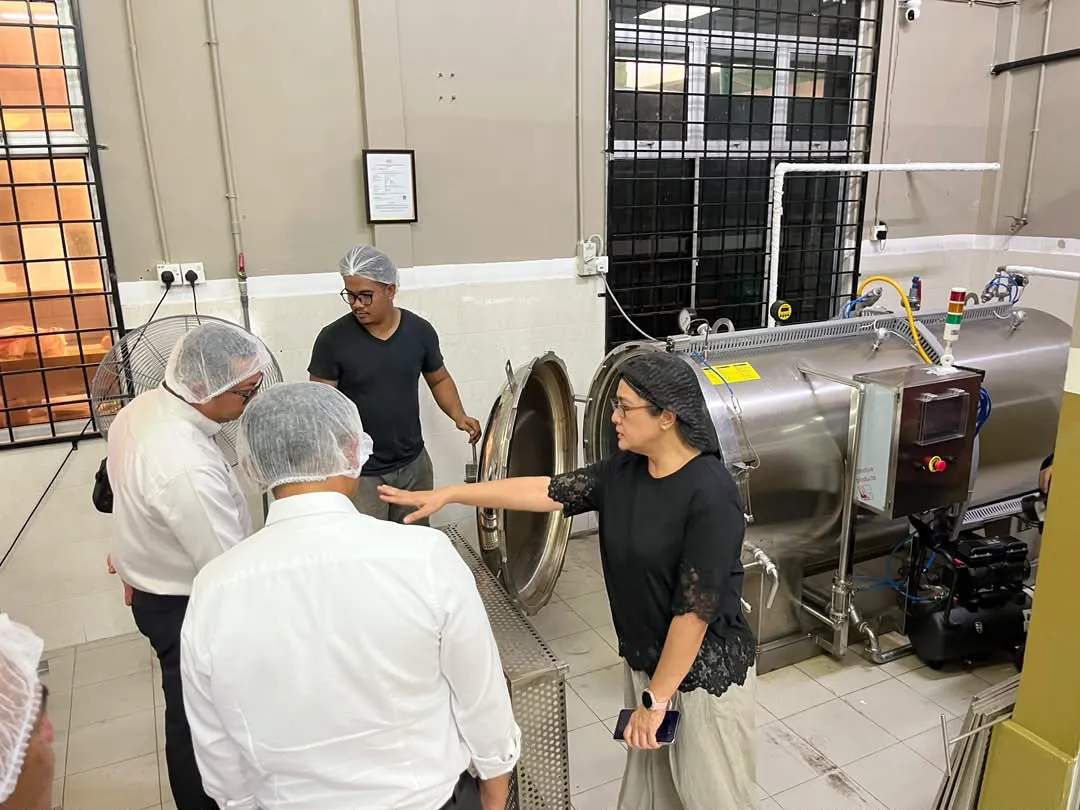
The retort at DapoGo's Melaka Halal Hub factory: pressure, temperature and time controlled in one chamber, not on a kitchen stove.
Not safely, and in Malaysia not under the home-based scheme. A commercial retort holds pouches above boiling point under controlled, recorded conditions; Oregon State University Extension says no researched method exists for retort pouches at home. Malaysia’s Ministry of Health (KKM) updated its home-based food guideline in October 2026, and names retort products among foods it does not offer listing to. Shelf-stable moist, low-acid products belong in a retort facility.
This guide is for founders who sell a sambal, curry or paste and want it to keep without a fridge. It is part of DapoGo’s halal OEM and co-packing guide, written from our own retort line at Melaka Halal Hub, Serkam, where we have run our factory since June 2026.
If the term is new, start with what retort processing is. This page answers the narrower question: can you do it yourself and sell the result?
Key points
- In a home canner there is no assurance the inside of a pouch reaches 240 to 250°F (about 116 to 121°C) for long enough, says OSU Extension.
- US rules for low-acid canned food require the process to be set by people with expert knowledge of thermal processing.
- KKM’s home-based listing guideline (Revision 2, October 2026) does not offer listing to retort products.
- DapoGo’s route starts with an RM250 consultation and a 300 to 500 pouch pilot batch.
On this page11 sections
Can you sell food you retorted at home in Malaysia?
Not as a listed home-based product. KKM runs a free listing for people who cook at home for sale, and its October 2026 guideline names food categories it does not offer listing to. One of them is food sterilised with pressure and high temperature, which is retort.
KKM’s reasoning is specific. A retort process needs control and monitoring of critical heat-processing parameters, process validation and packaging control to make the product microbiologically safe. Without that, the guideline says, the risk rises for products that could support the growth of Clostridium botulinum. It describes such foods as high-risk to make in a home kitchen, needing controls found in a manufacturing facility.
What does a commercial retort control that a pressure canner cannot?
Temperature inside the pack, and proof of it. Oregon State University Extension explains that commercial retorts heat pouches under controlled conditions to hotter-than-boiling temperatures that kill bacterial spores, and that the same conditions are not possible in home pressure canners. Home canning recipes were tested for jars, so a pouch in a home canner falls outside any tested process.
| What matters | Home pressure canner | Commercial retort (US rule) |
|---|---|---|
| Temperature in the pack | No assurance it reaches 240 to 250°F for long enough | Controlled; each retort carries a temperature-indicating device |
| Who sets time and temperature | No researched recipe for pouches | Qualified people with expert knowledge of thermal processing |
| Who runs it | Whoever is cooking | Operators supervised by someone who completed an approved course |
A slide in the factory briefing by Datin Zamzarina, DapoGo’s founder, calls the retort a “Giant Scientific Pressure Cooker”. The word doing the work is scientific, as the table shows. What changes when a home recipe moves into that machine is covered in home recipe to retort pouch.
Why is boiling, steaming or hot-filling a jar not enough?
Because the hazard survives boiling. The World Health Organization says boiling kills the active bacteria, but C. botulinum spores can remain viable after boiling, even for several hours. The spores can be killed by very high temperature treatments such as commercial canning.
The US National Center for Home Food Preservation does not recommend open-kettle canning, nor processing jars in ovens, microwaves or dishwashers. A Rasa.my tip calls steaming bottled sambal for 30 minutes ‘retort cara kampung’ and says it keeps a month outside the fridge. WHO lists inadequately processed home-bottled foods among the places botulinum toxin most often forms.
Which foods need a retort at all?
Low-acid, moist foods. Codex Alimentarius defines a low-acid food as one in which any component has a pH above 4.6 and a water activity above 0.85. WHO notes that C. botulinum does not grow in acidic conditions below pH 4.6.
So a sambal with anchovies, prawns, meat or coconut milk has to be measured, not judged by taste. Botulism is rare, but WHO says it can be fatal in 5 to 10% of cases. A product that is both low-acid and moist needs a retort or a fridge.
What paperwork does a properly retorted product carry?
A defined process and a record for every batch. The US is a useful benchmark because its rules are written out in detail. Under 21 CFR 108.35, processors of low-acid canned food file each scheduled process with the regulator, including its sterilizing value (F0) and critical factors, for each food in each container size. A review of retort processing describes F0 as the log reduction of bacteria at a defined point during the process.
OSU notes that commercial canneries use a processing time and recipe approved by a food scientist and keep detailed records on each batch. How we check a first run is set out in retort pilot batch, and how a shelf life is proven in retort shelf-life testing.
Is there a legal way to sell home-made sambal in Malaysia?
Yes: get listed under KKM’s free home-based scheme. Its guideline names sambal bilis, frozen rendang and homemade sauces as examples of processed food made by home-based sellers, so an ordinary cooked sambal can apply, subject to KKM’s assessment. The listing is valid for 3 years and covers your own kitchen only.
- Register with KKM on FoSIM.
- Every food handler attends KKM-recognised food handler training and has had the anti-typhoid vaccination.
- Labels meet the guideline’s requirements.
- Follow KKM’s home food safety guideline.
Our advice: if your sambal is moist, low-acid and not retorted, keep it in the fridge. KKM’s safety guideline says to keep cooked, perishable food below 5°C. Certification for a factory-made product is covered in MeSTI, halal and HACCP, and labelling in packaged food labelling.
Should you use a toll retort service or a co-packer?
A toll service retorts food you cooked; a co-packer cooks, fills and retorts at its own premises. Toll services exist in Malaysia; one Penang sambal maker charges a minimum of RM20 per 2 kg. Whichever you use, ask who set the process for your product and ask to see the batch records.
One Malaysian retort service lists four common beginner mistakes, including cooking early in the morning but retorting only at midday or later, and keeping no batch records. Pouches from a faulty process can start swelling 7 to 14 days later, it adds.
What does it cost to start with a retort factory?
DapoGo’s published OEM rates: an RM250 consultation (45 to 60 minutes, deducted from the R&D fee if you proceed within 7 days), custom recipe R&D from RM3,500 per SKU, and private label on an existing DapoGo formula from RM1,500. Pilot batches are 300 to 500 pouches per SKU and full production starts at 1,000. Payment is 70% deposit and 30% before delivery.
Artwork, lab tests, nutrition facts, barcodes and the halal application are excluded unless stated. The full sequence is on our OEM process and the scope on our co-packing services page.
Quick answers
Can I use my pressure cooker to make retort pouches for sale?
It is not advisable. Oregon State University Extension says there are no researched techniques or recipes for using retort pouches safely at home, and that the conditions of a commercial retort are not possible in home pressure canners. In Malaysia, KKM’s home-based listing does not cover retort products. Use a facility that sets and records the process.
How long does a properly retorted pouch last?
That depends on the product and the process, and is proven by testing rather than assumed. DapoGo publishes a 24-month ambient shelf life for its own range. A home-steamed jar has no comparable figure, because steaming is not a validated process. WHO notes that botulinum spores can survive boiling for hours.
What should I ask a toll retort service?
Ask who set the time and temperature for your product, and ask to see the batch records. A Malaysian retort service lists cooking in the morning but retorting only at midday or later, and keeping no batch records, as common beginner mistakes. Commercial canneries keep detailed records on each batch, notes OSU Extension.
Where to start
Start with one product that already sells. Bring the recipe, how you sell it today and where you want it sold next. The jar-or-pouch choice is in glass jar or retort pouch and other questions in the DapoGo FAQ. To ask us directly, WhatsApp 011-5501 3391.
Sources
- KKM, Home-Based Food listing guideline (Garis Panduan Permohonan Penyenaraian Pengusaha Makanan Sediaan di Rumah), Revision 2, October 2026
- KKM, Home-Based Food safety guideline, Revision 2, October 2026
- Oregon State University Extension, Are retort pouches safe for pressure canning?
- World Health Organization, Botulism
- National Center for Home Food Preservation, Equipment and Methods Not Recommended
- Codex Alimentarius, Code of Hygienic Practice for Low and Acidified Low Acid Canned Foods
- US eCFR, 21 CFR Part 113 and 21 CFR 108.35
- Understanding retort processing: A review
- Rasa.my, sambal tip (in Malay)
- RetortLab, common mistakes of new retort entrepreneurs (in Malay)
- Buletin Mutiara, a Penang retort service (in Malay)
Want this made for your brand?
WhatsApp 011-5501 3391