OEM & Co-packing
Bulk Halal Ready-to-Eat Meals Malaysia: A B2B Buyer’s Guide
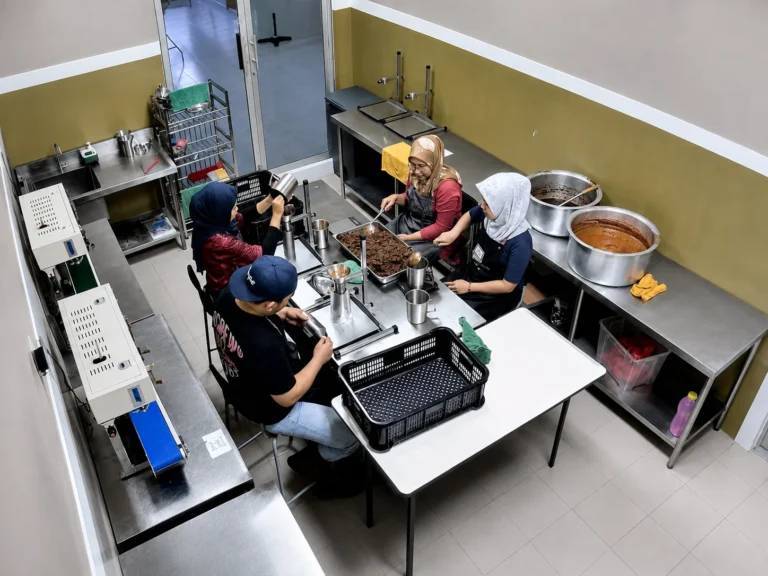
Dishes cooked in bulk pots, then filled into pouches before retort processing.
Any bulk ready-to-eat supplier will tell you their meals are shelf stable. Few will show the documents that prove it. Three things separate a supplier you can buy from in volume from one with a good website: a verifiable halal certificate for the specific SKU, a lot code on every pouch, and retort processing records. Ask for all three before you ask the price.
This guide is written from our own factory kitchen at Melaka Halal Hub, for the buyer rather than the brand owner: procurement, event planners, gifting managers, hostel and canteen operators, NGOs packing relief boxes. The brand-owner side of the same factory is our halal OEM and co-packing guide. This is for mid-sized orders, hundreds to a few thousand pouches, not industrial catering tenders.
The short version
- “Shelf stable” is a standards definition: what cannot grow in the food, not how long the brand says it keeps.
- Every sealed pouch should carry a lot code naming the plant, the product and the packing day.
- Food in the 10–60°C band may not be held there more than four hours, and catered food that is not eaten is discarded.
On this page10 sections
What should you ask a bulk halal ready-to-eat supplier first?
Start with halal. Ask for the halal certificate covering that exact SKU rather than the brand, check that it has not expired, and check the number with the body named on the certificate — JAKIM numbers on the JAKIM halal portal. Then ask for the lot code and the retort records.
SupplyBunny‘s halal distributor guide names both traps: “Do not assume a product is halal because the brand is — check each specific SKU.” And “Ask to see the certificate and check the expiry date.”
Sumatraa’s bulk page, the closest competitor on this query, advertises “bulk orders at competitive prices” without naming a minimum order, a lead time or a price.
What does “shelf stable” actually have to mean?
“Shelf stable” is not a marketing word. The Codex code for low-acid canned foods defines the condition a retort has to reach as commercial sterility: heat enough to leave the food free of microorganisms able to grow at the unrefrigerated temperatures it meets in distribution and storage.
Commercial sterility is heat applied “to render the food free from microorganisms capable of growing in the food at normal non-refrigerated conditions at which the food is likely to be held during distribution and storage”.
Codex Alimentarius, CXC 23-1979, 2.9
The same code defines a retort as “a pressure vessel designed for thermal processing of food packed in hermetically sealed containers”: the food is sealed first and cooked afterwards, so nothing is added later to keep it, because nothing gets back in.
The buyer’s real question is who measured that it keeps. DapoGo publishes a 24-month ambient shelf life and 3 to 5 minute heating for its own products; how an expiry date is proven is a separate piece.
Which documents can you ask to see?
Those three plus three more carry this conversation: the halal certificate for the SKU, the lot code on the pouch, the retort processing records behind it, the shelf-life study behind the date, the label if the pouch carries your name, and a written order document before you pay.
- The halal certificate for the SKU — current, and verified with the body named on it.
- The lot code on the pouch. Codex says the code mark should identify “the establishment where the product was packed, the product, the year and the day of the year”, so a lot can be isolated.
- The retort records. Codex requires permanent, legible dated records of time, temperature and code mark for every retort load, kept three years or more.
- The shelf-life study, not the date on its own.
- The label. If the pouch carries your organisation’s name, its label is your problem too; see our guide to packaged food labelling.
- A written order document — confirmation, deposit, payment method, cancellation terms, items and total, the standard Malaysia’s catering guideline sets for caterers.
Hot-held, frozen or shelf stable: what each one costs you
The three routes differ less in price per head than in what they assume you already own: equipment and staff for hot-held catering, a freezer you own and monitor for frozen, dry shelving and hot water for shelf-stable pouches. Anything hot-held and not eaten is discarded.
| Route | Storage temperature | What you must own | What happens to leftovers |
|---|---|---|---|
| Hot-held catering | Above 60°C until served | Hot boxes, temperature-controlled transport, staff | Discarded |
| Frozen | -18°C or colder | Freezer capacity, space, temperature monitoring | Discarded once served; unserved stock may not be refrozen |
| Shelf stable pouches | Room temperature | Dry shelving and hot water | Keeps for another day while sealed |
Codex puts self-service food either below 4°C or above 60°C, calls 10°C to 60°C the hazardous range, and says the product “should not be maintained in this temperature range for more than 4 hours”. Cooked-frozen food sits at or below -18°C, and may be held at or below 4°C “for not more than five days and should not be refrozen”. The technical comparison is in retort vs frozen vs vacuum.
Relief, NGO and field orders: what to specify
Relief buyers have the clearest brief here: the recipient has no kitchen at all. Specify by headcount — count people, not kilograms. Sumatraa, the closest competitor on this query, specifies its relief packs as one rice, one dish, a spoon and fork and a container per person.
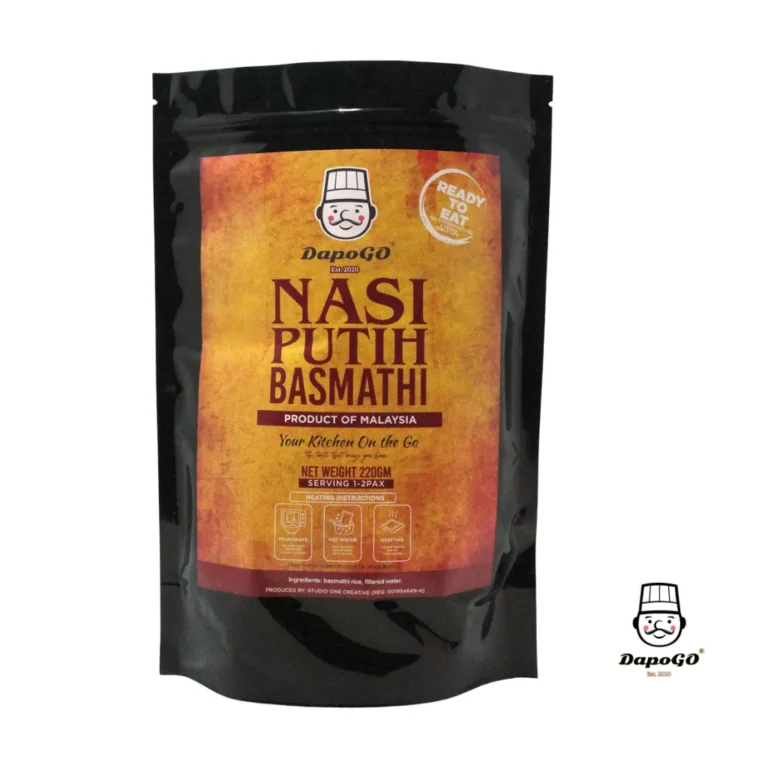
DapoGo’s rice range is sold in single-serve sealed pouches, so a headcount converts straight into rice pouches and dishes; where there is no fire or electricity, a heat pad is an add-on. The household version is our flood and monsoon food kit guide.
WHO‘s 2026 estimates put foodborne illness at more than 866 million cases and 1.52 million deaths in 2021. WHO attributes 29 per cent of the health burden of unsafe food to children under five, with 143,000 deaths in that group.
Corporate gifting: a meal pouch is not a hamper
Malaysian corporate food gifting is almost entirely snacks, dates and nuts: snacks survive a courier and cooked food does not. A sealed retort pouch is the exception, because it was cooked inside the packaging it ships in, which makes dinner rather than dessert a possible gift.
DapoGo’s published range sits at RM10 to RM27 for single SKUs and RM45 to RM122 for bundles, across 54 products in seven categories. It needs a sensible bundle and a label you are happy to put your logo beside, not a custom production run.
How much do you have to order, and when does it become OEM?
Two different transactions. Buying in bulk means DapoGo’s products as they are, in DapoGo’s packaging; bulk pricing and quantities are not published, and are quoted per order over WhatsApp. OEM means the product leaves with your brand on it, and those figures are published.
OEM pricing: RM250 consultation, from RM1,500 private label, from RM3,500 custom recipe, from RM5,000 complex development. Trial batches start at 200 units, pilot batches run 300 to 500 pouches, full production from 1,000 pouches per SKU, on 70 per cent deposit and 30 per cent before delivery. Stages: consultation 1 to 2 days, sampling and taste testing 2 weeks, production 1 to 2 months — not a single lead time. Recipe revisions are capped at three: a policy, not a stage.
The full route is on the DapoGo OEM process page, the scope on halal OEM and co-packing services.
Quick questions
Can we keep catered food that was not eaten?
Not once it has been served. Codex says food not consumed should be discarded and neither reheated nor returned to chilled or frozen storage, which is why Malaysia’s catering guideline tells caterers to confirm the guest count early. Sealed pouches never opened are a different matter.
Do we need a kitchen to serve ready-to-eat pouches?
No. A pouch goes into hot water and comes out ready — DapoGo publishes 3 to 5 minutes — so dry shelving, a pot and a heat source cover it. Where there is no kitchen, fire or electricity, DapoGo sells a heat pad and a heat box as add-ons.
How do we check a shelf-life claim?
Ask which study produced the date and when it was done. A date is a conclusion; the study is the evidence. DapoGo publishes a 24-month ambient shelf life for its own products, and how that kind of date is proven is in our shelf-life testing guide.
Where to start
Start with one event or one month of a canteen, not a year. Convert the headcount into pouches and order small — trial batches start at 200 units. More answers are in the FAQ, the vocabulary in the retort food glossary. To ask directly, WhatsApp 011-5501 3391.
Sources
- Codex Alimentarius, Code of Hygienic Practice for Low and Acidified Low Acid Canned Foods (CXC 23-1979)
- Codex Alimentarius, Code of Hygienic Practice for Precooked and Cooked Foods in Mass Catering (CXC 39-1993)
- SupplyBunny, Halal Food Distributors Malaysia 2026
- World Health Organization, Food safety fact sheet
- KPDN, Garis Panduan & Kod Etika Perkhidmatan Katering
- Sumatraa Industries, Ready-to-Eat Food Supplier in Malaysia
Want this made for your brand?
WhatsApp 011-5501 3391