
OEM & Co-packing
Sambal Co-Packing: Glass Jar or Retort Pouch?
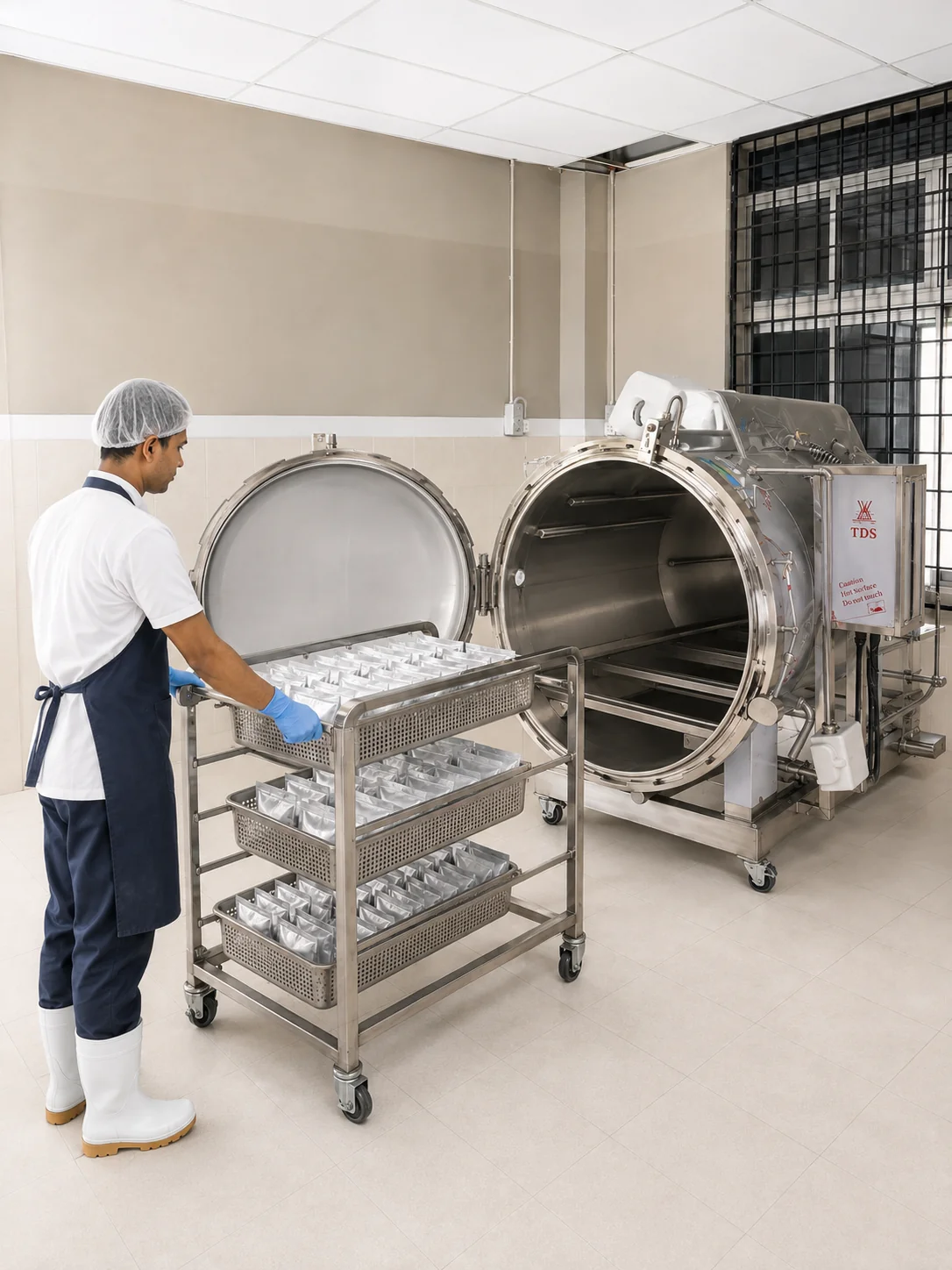
Pouches going into the retort at DapoGo's Melaka Halal Hub factory. The process decides the container.
Codex draws the low-acid line with two thresholds: pH 4.6 and water activity 0.85. A sambal at or below pH 4.6 can go into a glass jar with a much lighter heat process. One above pH 4.6 with water activity above 0.85 needs a full retort to keep on a shelf. Pouch supplier Ezypak calls aluminium a suitable starting option; jars can be retorted too.
This guide is for founders putting a sambal under their own label through a Malaysian co-packer: a family recipe that already sells, a restaurant’s signature sambal, or a brand for buyers abroad who will never see it before it arrives. For the wider route, start with DapoGo’s guide to halal OEM and co-packing in Malaysia. Here we deal with one decision that shapes every other: the container.
If you are choosing which sambal to buy rather than which one to make, our retort sambal vs jarred sambal comparison covers the eating side.
Key takeaways
- Codex treats a food as low-acid when its pH is above 4.6 and its water activity above 0.85. Both readings decide the process.
- A 2021 study measured fish retorted in balado, rendang and sambal goreng sauces at pH 5.66 to 5.9, well above 4.6.
- Glass can go through a retort, but the lid and sudden cooling are its weak points.
- Where a covered food’s date mark depends on storage, Malaysian rules require the storage direction on the label.
On this page10 sections
Jar or pouch: what does each one commit you to?
A jar commits you to lid care and slow cooling in the retort; a pouch commits you to a retort with over-pressure. Ezypak, a Malaysian pouch supplier, calls aluminium a suitable starting option for sambal for its light, oxygen and moisture protection. It also says “The pouch alone does not determine shelf life.” The recipe and the process do.
| What you are deciding | Glass jar | Aluminium retort pouch |
|---|---|---|
| Which sambals suit it | A sambal at or below pH 4.6 with a lighter process, or a retorted jar handled with care | A suitable starting option for sambal, per Ezypak |
| Weak point in processing | The lid, and thermal shock while cooling | Needs a retort with over-pressure, which Codex names for flexible containers |
| What the buyer sees | The sambal itself, through the glass | The printed pouch; aluminium blocks light, oxygen and moisture |
| Shipping | Fits when buyers expect the category in a rigid container | Often stronger when weight and shipping efficiency matter |
Packaging supplier Anacotte says pouches tend to win “when weight reduction, shipping efficiency, and flexible processing compatibility matter more than rigid shelf conventions”. Selling online is covered in your food brand on Shopee and TikTok Shop.
Why does acidity decide the container?
Because the Codex code for shelf-stable food in sealed containers sorts food by acidity and water activity. Food with a component above pH 4.6 and water activity above 0.85 is low-acid; at water activity 0.85 or below it is outside that definition, whatever the pH. Codex warns that such food may support heat-resistant spore-formers such as Clostridium botulinum, and calls its heat processing a very critical operation.
Low-acid food: “means any food, other than alcoholic beverages, where any component has a pH value greater than 4.6 and a water activity greater than 0.85.”
Codex Alimentarius, CXC 23-1979, 2.19
That heat processing is the job a retort does: a pressure vessel that heat-processes food already sealed in its container.
Where does sambal sit? It depends on the recipe. A 2021 Universitas Gadjah Mada study packed smoked catfish into retort pouches with balado, rendang and sambal goreng sauces, sterilised them at 121°C for 20 minutes, and measured pH 5.66, 5.66 and 5.9 over eight weeks of storage. Those were their samples, not yours, so ask your co-packer how your sambal’s pH and water activity will be confirmed.
Can a sambal be hot-filled into a jar?
Yes, if it is acidified. Codex defines an acidified low-acid food as one treated to reach an equilibrium pH of 4.6 or lower after heat processing, and says the heat treatment it needs is “much less” than a low-acid food’s. Codex also describes hot-fill and hold as a heat-processing technique, provided every inner surface of the container reaches the scheduled sterilisation temperature.
A 2021 study in Jurnal Aplikasi Teknologi Pangan tested andaliman sambal in retort pouches and settled on 35 minutes’ sterilisation with 3% citric acid. Against the control sambals, taste was the one sensory attribute that differed. Adding acid changes the recipe, so taste the soured version before choosing a jar.
What does glass need inside a retort?
Gentler handling than a pouch. Codex says glass closures are “particularly susceptible to mechanical damage which may result in a temporary or permanent loss of hermetic seal”, so sealed jar lids should sit within the glass body’s diameter. In the retort, cooling water should be introduced so it does not strike the jars directly, and the cooling medium is brought down slowly at first, both to prevent breakage by thermal shock.
Which Malaysian rules apply to a bottled chilli product?
If the product is sold in Malaysia as chilli sauce, regulation 342 of the Food Regulations 1985 applies. It requires at least the equivalent of 5 per cent w/w chillies, at least 25 per cent total soluble solids and at least 0.8 per cent total acidity expressed as acetic acid, and no sign of fermentation when incubated at 37°C for 15 days. Check with the Ministry of Health whether your sambal falls under it.
On labelling, regulation 14(6) says that where the validity of the date marking of a food it covers depends on its storage, the storage direction must also be on the label. Confirm how that applies to your jar through the Ministry of Health’s (KKM) own label review, which costs RM250 per application. The full label checklist is in our packaged food labelling guide.
How does DapoGo handle both?
It sells both today. Sambal Kicap Johor (200gm, with limau kasturi among its ingredients) comes in a glass bottle whose product page tells buyers to keep it in the chiller once opened. Sambal Jering Atok (180gm, made with anchovies) comes in an aluminium pouch. The rest of the range is in the ready-to-eat sambal category.
For OEM, DapoGo’s formats, supplied in writing, are stand-up and pillow aluminium retort pouches plus glass jars for sambal, from its factory kitchen at Melaka Halal Hub. The written terms do not set out how a jar is processed or a jar minimum, so ask about both at the consultation. What changes when a home recipe meets a factory is in home recipe to retort pouch.
What does it cost to start?
DapoGo’s published OEM rates: RM250 consultation, private label from RM1,500, custom recipe development from RM3,500 and complex development from RM5,000. A pilot batch is 300 to 500 pouches per SKU and full production starts from 1,000 pouches per SKU, on 70% deposit and 30% before delivery. Artwork, lab testing, nutrition facts, barcode and the halal application are excluded unless stated.
The stages are consultation 1 to 2 days, sample and taste testing 2 weeks, and production 1 to 2 months, and recipe revisions are capped at 3. The rate card counts in pouches. The full sequence is on the DapoGo OEM process page and the scope on DapoGo’s OEM and co-packing services.
FAQ: sambal in jars and pouches
Does a co-packed jar of sambal need preservatives?
Not necessarily. Malaysia’s chilli sauce standard permits approved preservatives but does not require them. A sambal that keeps on a shelf without them does so because of its process: sour enough for a hot fill, or retorted to commercial sterility.
Can an anchovy sambal go into a glass jar?
Yes, but it may well be low-acid, and if so it needs a full retort process with careful glass handling, or a recipe acidified to pH 4.6 or below. A 2021 study measured fish retorted in balado, rendang and sambal goreng sauces at pH 5.66 to 5.9. Ask your co-packer how your own sambal’s pH and water activity will be confirmed.
Is a pouch better for shipping than a jar?
Often, according to Anacotte Packaging: pouches tend to be the stronger choice when weight and shipping efficiency matter, while jars fit when buyers expect a rigid container or a traditional look. For courier and cross-border orders, that difference repeats on every parcel, so weigh it before you choose.
Where do you start with a co-packed sambal?
Start with one sambal, not a range. Bring the recipe, decide where it will be sold, and let the sambal’s pH and water activity choose the container. More answers are in the DapoGo FAQ. To ask directly, WhatsApp +60 11-5501 3391.
Sources
- Codex Alimentarius, Code of Hygienic Practice for Low and Acidified Low Acid Canned Foods (CXC 23-1979)
- Ministry of Health Malaysia, Food Regulations 1985 (updated to August 2026), regulations 14 and 342
- Universitas Gadjah Mada (2021), smoked catfish in retort pouches with traditional sauces
- Permana et al., Jurnal Aplikasi Teknologi Pangan 10(2), 2021, andaliman sambal in retort pouches
- Ezypak, Best Retort Packaging for Sambal, Curry & Ready Meals
- Anacotte Packaging, Retort Pouch vs Jar Packaging
Want this made for your brand?
WhatsApp 011-5501 3391