Meals On the Go
Halal Food for Muslim Tour Groups: Europe, UK & Japan
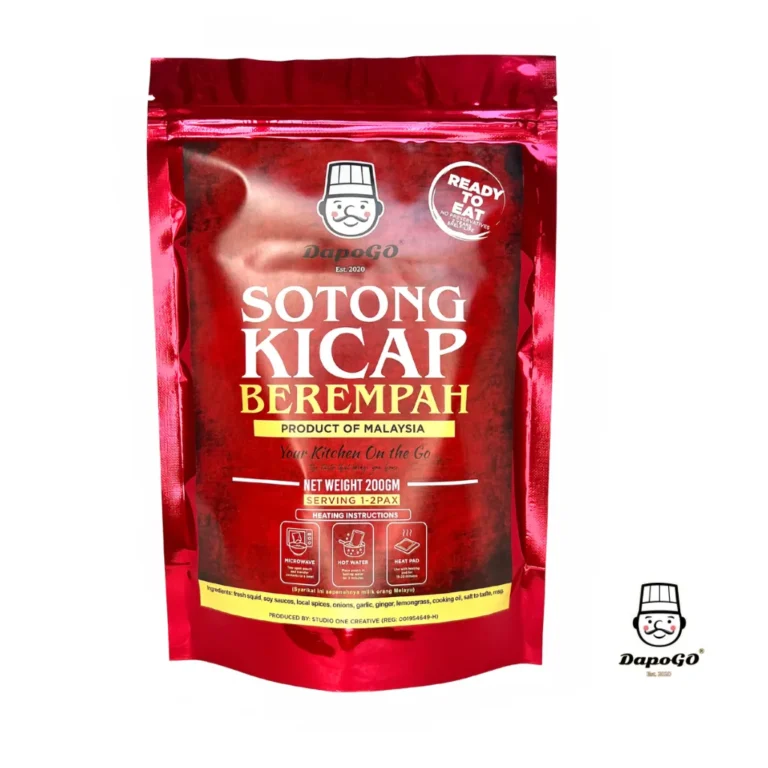
Sotong Kicap Berempah: a seafood pouch whose ingredient list has no meat, eggs or dairy
A Muslim tour group can carry halal ready-to-eat food to Europe, the UK and Japan, but not meat. According to the European Commission, GOV.UK and Japan’s Animal Quarantine Service, travellers from Malaysia cannot bring in meat products; Japan’s page adds this holds even when heat-processed, and the EU and UK bar dairy too. Plan around pouches whose ingredient list shows no meat, eggs or dairy.
This guide is for travel agents and tour leaders taking Muslim groups to non-Muslim countries. DapoGo Food Industries cooks ready-to-eat Malaysian dishes in retort pouches at our own plant in the Melaka Halal Hub, and this piece sits inside our wider guide to when ready-to-eat meals earn their place; umrah has its own umrah and travel food guide. The question here is narrower, and agents hear it often before a Europe or Japan departure: what can go in the suitcase, and what gets taken away at arrivals.
Key takeaways
- EU: travellers from a non-EU country “are not allowed to bring any meat or dairy products”, and the same rule covers Switzerland and Norway (European Commission, Your Europe).
- UK (Great Britain): meat, meat products, milk and milk-based products from outside the EU are refused; fish and fish products are allowed up to 20kg per person (GOV.UK).
- Japan: meat products without a government inspection certificate are refused, even when heat-processed; fish products with no livestock meat or eggs are not subject to animal quarantine inspection (Animal Quarantine Service).
- A halal logo earns no exemption. These are animal-disease rules, not rules about how food is prepared.
- Examples of DapoGo products whose ingredient lists show no meat, eggs, dairy or unspecified flavouring: Sotong Kicap Berempah, Sambal Jering Atok, Chili Oil, Nasi Putih Basmathi and Sambal Kicap Johor.
On this page10 sections
Why do Muslim tour groups need to carry food at all?
Muslim tour groups carry food because a tour schedule does not always pass a halal restaurant at mealtime. The Mastercard-CrescentRating Global Muslim Travel Index 2026 counts 196 million Muslim international arrivals in 2025, up 11.3% on the year, and projects 262 million by 2030. It names certified halal dining among the services that move bookings: “Prayer facilities, certified halal dining and Muslim-friendly stays move both score and bookings.”
A typical package covers halal meals in three layers. Dinners are booked ahead at halal restaurants, usually through the ground handler at the destination. Hotel breakfasts are checked with the hotel. Then come the gaps no booking covers: the long coach day between two cities, the late arrival after a flight, the small town with nothing halal within walking distance. A restaurant’s halal status is worth confirming in writing, including which body certified it.
For a travel agent, carried ready-to-eat food is not a replacement for booked halal restaurants; it is the fallback for the meals that fall outside the restaurant schedule.
Can you bring Malaysian food into the EU, the UK or Japan?
Malaysian ready-to-eat food can go to the EU, the UK and Japan, with three exceptions: meat products everywhere, dairy in the EU and UK, and eggs in Japan. The EU’s official page says travellers from non-EU countries “are not allowed to bring any meat or dairy products”. GOV.UK lists “meat or meat products” and “milk or milk-based products” under “You cannot bring in” for food from outside the EU.
| Destination | Meat, chicken, dairy and eggs | Fish and seafood | Official source |
|---|---|---|---|
| European Union (including Switzerland and Norway) | Meat and dairy not allowed from non-EU countries | “Prepared or processed fishery products”: up to 20kg or one fish per person, whichever weighs more | Your Europe |
| United Kingdom (Great Britain) | Meat, meat products, milk and milk-based products not allowed from outside the EU | Up to 20kg per person, including fish that is dried, cooked, cured or smoked, and prawns | GOV.UK |
| Japan | Meat products and eggs not allowed without a government inspection certificate, even if heat-processed or vacuum-sealed | Fish products with no livestock meat or eggs are not subject to animal quarantine inspection; an officer may check on arrival | Animal Quarantine Service |
This table was checked against all three official pages on 15 October 2026. Rules change, so check again close to departure.
“Europe” is not one rulebook. Your Europe says that in this context “EU includes the 27 EU countries, Andorra, Iceland, Liechtenstein, Norway, San Marino, Switzerland”, so a Paris–Switzerland tour follows one rule. The UK has its own, and the GOV.UK page covers Great Britain (England, Scotland and Wales), so a London–Paris itinerary crosses two sets of rules.
Japan is the most explicit about cooking. Its Animal Quarantine Service answers the question of heat-processed food directly: items without an inspection certificate “cannot be brought in, even if they have been heated processed.” A meat retort pouch, sterilised by heat, falls inside that Japanese ban.
Does halal certification help at the quarantine counter?
Halal certification does not exempt food from EU, UK or Japanese quarantine rules, because those rules exist to keep animal diseases out, not to judge how food was prepared. Japan’s Animal Quarantine Service gives the reason in one line: “African swine fever, foot and mouth disease, avian influenza and other animal infectious diseases are spreading all over the world.”
A halal mark describes slaughter and processing under Islamic law, not the disease status of the animal. None of the three official pages makes an exception for halal food, cooked food or food in a sealed pack. The exceptions the EU and UK pages do list are powdered infant milk, infant food and special medical food, up to 2kg.
What the halal label on a ready-to-eat pouch does mean is covered in is ready-to-eat food halal, and why a sealed retort pouch keeps without a fridge is explained in what is retort processing.
Which DapoGo products suit a Europe, UK or Japan tour?
DapoGo’s range splits into three groups by the ingredient lists we publish on each product page. Meat stays at home for all three destinations; butter or ghee stays at home for the EU and UK. Seafood products whose ingredient list shows no meat, eggs or dairy are the core of the packing list, and products with no meat, fish, eggs or dairy at all are untouched by those bans.
| Group | DapoGo examples | For the EU, UK and Japan |
|---|---|---|
| Contains beef, chicken or lamb | Rendang Minang Daging, Nasi Briyani Ayam Batu Pahat (ghee is also on its ingredient list), Daging Kicap Berempah | Leave at home |
| Seafood, with no meat, eggs or dairy on the ingredient list | Sambal Jering Atok (bird’s-eye chilli, jering, anchovies, shallot, garlic, tamarind slices, salt, sugar), Chili Oil (dried chilli, oils, dried shrimp, garlic, shallot, salt, sugar), Sotong Kicap Berempah (squid, soy sauces, spices, shallot, garlic, ginger, lemongrass, sugar, salt) | EU and UK: anchovies and shrimp are fish products within the 20kg per-person allowance; GOV.UK’s list does not name squid, so declare it if unsure. Japan: fish products with no livestock meat or eggs are not subject to animal quarantine inspection |
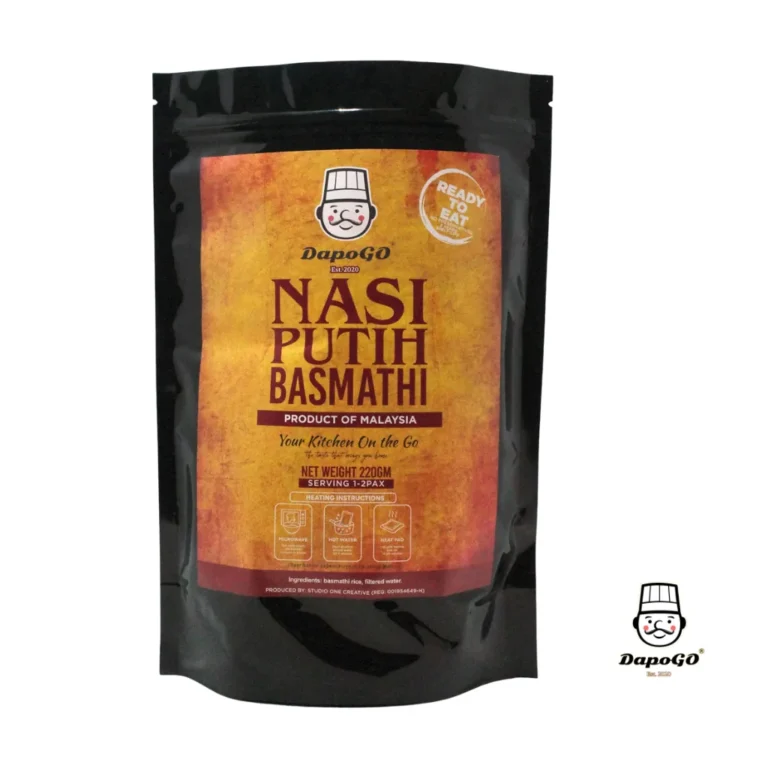
| No meat, fish, eggs or dairy on the ingredient list | Nasi Putih Basmathi (basmati rice and filtered water), Sambal Kicap Johor (in a glass bottle: bird’s-eye chilli, garlic, shallot, salt, sugar, soy sauce, calamansi) | Untouched by the meat, dairy and egg rules |
Our other seafood products, namely Sambal Petai Udang, Sambal Petai Bilis, Sambal Tumis Cumi, Sambal Tumis Bilis Oldskool, Sambal Tempoyak Bilis Cili Api and Nasi Lemak Sambal Tumis Bilis, list “perasa yang dibenarkan” (permitted flavouring) among their ingredients. Before packing them for these three destinations, WhatsApp DapoGo to confirm what that flavouring contains. One tip from our kitchen: keep every pouch in its original pack, because the label is what an officer reads.
DapoGo’s beef and chicken pouches still suit trips to destinations whose rules allow them; check that country’s official page before adding them to a packing list. If your agency wants DapoGo stocked abroad rather than carried, that is an export question, covered in exporting halal ready-to-eat food to Singapore and the UK.
How much food should a tour group pack?
A tour group should pack by meals, not days: count the meals with no halal restaurant booked, then allow one rice pouch per person, one side dish between two and one sambal between four. DapoGo’s product pages give Nasi Putih Basmathi as one to two servings and Sotong Kicap Berempah as two to three. For 20 travellers and three hotel-room dinners, that is 105 pouches, about 21.3kg, or roughly 1.1kg each.
| Item | Basis | 20 people × 3 meals | Net weight |
|---|---|---|---|
| Nasi Putih Basmathi (220g) | 1 pouch per person | 60 pouches | 13.2kg |
| Sotong Kicap Berempah (180g net) | 1 pouch per 2 people | 30 pouches | 5.4kg |
| Sambal Jering Atok (180g) | 1 pouch shared by 4 | 15 pouches | 2.7kg |
| Total | 105 pouches | 21.3kg, about 1.1kg per person |
Sambal is eaten a spoonful at a time as a condiment, so the example shares one pouch between four; raise that for a group that loves heat. Even if every seafood side dish and sambal in this example counted towards the fish allowance, it would come to about 0.4kg per person, far below the 20kg EU and UK limit. The real limit is each traveller’s baggage space.
Split the food across the group’s suitcases rather than one bag carried by the tour leader: the EU and UK fish allowance is counted per person. For a longer tour, repeat the same count; our week of ready-to-eat meals shows the method across seven days.
How does a tour group heat pouches without a kitchen?
A tour group heats DapoGo pouches in hotel rooms with hot water from the room kettle, no stove needed. The Sotong Kicap Berempah page says to heat the pouch in boiling water for 2 minutes; the Nasi Putih Basmathi page says to heat it unopened in boiling water. Those times assume water at a boil. Kettle water in a container cools fast, so soak longer and top up with freshly boiled water.
Use a heat-proof container or the room’s ice bucket. Confirm an in-room kettle when booking each hotel, or bring a travel kettle. Never put the foil-lined pouch in a microwave; tip the food onto a plate first. A sealed DapoGo pouch needs no fridge on the road: our product pages state the pouches keep for up to two years at room temperature. Finish an opened pouch at that meal.
The detail is in how long retort food lasts, and heating and storage in how retort food keeps without preservatives. If you want to pack our Heat Pad, ask the airline first.
What should the tour leader do before and at the airport?
The tour leader’s job is to check, split, label and declare the group’s food. Rules change, so read each country’s official page close to the departure date. Japan’s Animal Quarantine Service is blunt about skipping the last step: “If you failed to declare meat or animal products and found them in your luggage, you will be found punishable.”
- Read the official page for every country on the itinerary close to departure, including transit countries where the group passes through immigration.
- Remove anything with beef, chicken or lamb (all three destinations), eggs (Japan), and butter or ghee (the EU and UK) from the list.
- Confirm an in-room kettle at each hotel, or pack a travel kettle.
- Split the food across travellers, in its original labelled packs, in checked baggage. Wrap glass bottles in clothing. For cabin bags, check the airline’s and airport’s liquid limits.
- Brief the group in one line: if in doubt, declare.
- Carry a group packing list (product names and weights) to show an officer who asks.
How to declare differs by country. In the UK, GOV.UK tells travellers who are unsure to speak to a Border Force officer in the “red channel” at customs, and says undeclared banned food can bring a fine of up to £5,000 in England. In the EU, Your Europe says undeclared meat or dairy will be confiscated and destroyed, with a possible fine. In Japan, inspection happens at the Animal Quarantine Service counter in the baggage claim area.
Japan’s Animal Quarantine Service says that bringing in meat or animal products illegally is punishable with a custodial sentence of up to 3 years or a fine of up to 3 million yen. Its detector dogs are trained to find meat products in both checked and carry-on bags.
Frequently asked questions
Does chicken count as meat?
Yes. Japan’s Animal Quarantine Service lists chicken among the poultry whose products are subject to quarantine, the EU page bars “any meat”, and GOV.UK bars “meat or meat products” from outside the EU. For an EU, UK or Japan tour, chicken pouches such as Nasi Briyani Ayam Batu Pahat come off the packing list along with beef and lamb.
Do Switzerland and Norway follow the EU rule?
Yes, for food carried by travellers. Your Europe says that in this context “EU includes the 27 EU countries, Andorra, Iceland, Liechtenstein, Norway, San Marino, Switzerland”. So the meat and dairy ban, and the 20kg per-person allowance for fishery products, also apply to a tour group entering Switzerland or Norway from Malaysia.
Can seafood pouches go to Japan?
According to Japan’s Animal Quarantine Service, dried fish and other fish products that do not contain meat from livestock or eggs are not subject to its inspection. An officer may still check on arrival that they contain no meat. Keep pouches such as Sambal Jering Atok in their original pack so the ingredient list is easy to read.
What is the penalty for bringing meat into Japan?
Japan’s Animal Quarantine Service says bringing in meat or animal products illegally is punishable with a custodial sentence of up to 3 years or a fine of up to 3 million yen, and that a traveller who fails to declare meat later found in their luggage is punishable. The safe brief for every traveller is simple: if in doubt, declare at the animal quarantine counter.
Can a travel agent order DapoGo food for a whole group?
Yes. WhatsApp DapoGo on +60 11-5501 3391 with the destination, dates and group size. DapoGo will suggest a mix of seafood and meat-free pouches for the group’s itinerary, and confirm the ingredient list of any pouch you want to take to the EU, the UK or Japan.
Where to start
Start with the itinerary: list the countries, then the meals with no halal restaurant booked. The pouch count follows from there. If you are a travel agent planning a Muslim tour to Europe, the UK or Japan, send us the destinations, dates and group size and we will reply with a suitable mix: WhatsApp DapoGo on +60 11-5501 3391.
Sources
- European Commission, Your Europe: Taking animal products, food or plants with you (accessed 15 October 2026)
- GOV.UK: Bringing food into Great Britain, meat, dairy, fish and animal products (accessed 15 October 2026)
- GOV.UK: Bringing food into Great Britain, if you break the rules (accessed 15 October 2026)
- Animal Quarantine Service, Japan’s Ministry of Agriculture, Forestry and Fisheries: Bring animal products into Japan (accessed 15 October 2026)
- Mastercard-CrescentRating: Global Muslim Travel Index 2026 (11th edition, June 2026) (accessed 15 October 2026)
Want to try DapoGo?
WhatsApp 011-5501 3391