
OEM & Co-packing
Exporting Halal Food From Malaysia to Singapore & the UK
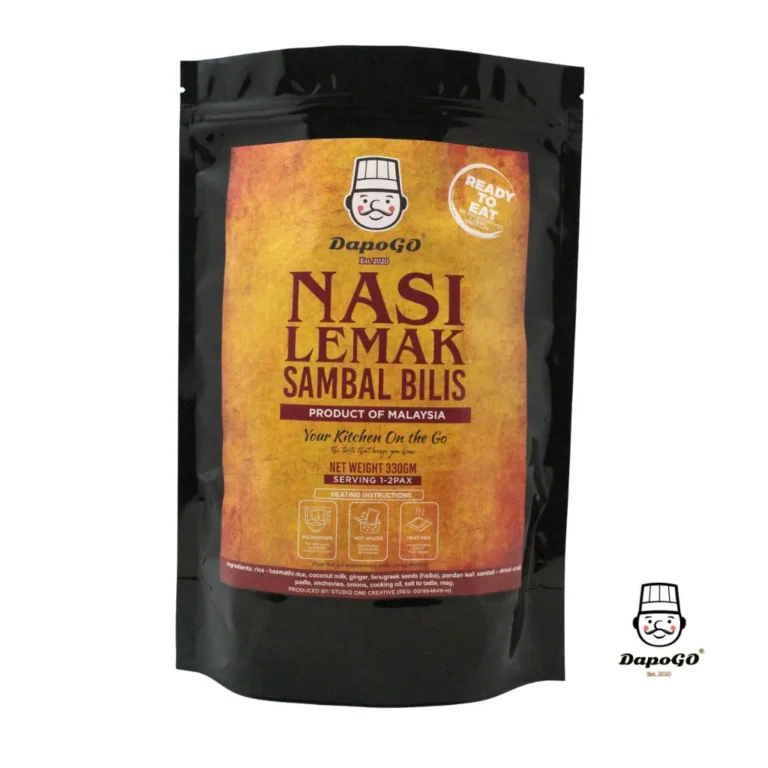
DapoGo Nasi Lemak Sambal Bilis set in a retort pouch
Two governments, two separate jobs. Singapore requires the importer to hold an SFA licence or registration. Malaysia requires your processing premises to be listed by its Ministry of Health, under a bilateral programme running since 2014. Great Britain treats a meat-and-plant pouch as a composite product, treats non-EU composites as medium risk by default, and rates them low risk where they are shelf stable at ambient temperature and sterilised.
This page sits under our halal OEM and co-packing guide, written by the DapoGo team, who cook and retort-pack ready-to-eat Malaysian food at our own factory in the Melaka Halal Hub.
Both markets buy what they cannot make. SFA’s Singapore Food Statistics 2025 reports that Singapore imports more than 90 per cent of its food. In England and Wales, the ONS 2021 census counted 3.9 million people who described themselves as Muslim, 6.5% of the population.
Key takeaways
- GB treats non-EU composite food as medium risk by default, and as low risk where it is shelf stable at ambient temperature and sterilised.
- Low-risk commodities face no routine border inspection; medium-risk ones are inspected at between 1% and 30%.
- Singapore’s processed-food import registration excludes anything containing meat and fish products, fresh fruits or vegetables.
- JAKIM appears on MUIS’s published list of recognised foreign halal certification bodies.
- A Malaysian premises listing for export to Singapore is valid for 3 years.
Which government do you deal with first?
Both, and they ask different things of different parties. Singapore’s import licence sits with the importer: SFA requires that company to be ACRA-registered with a UEN activated with Singapore Customs. That is usually your buyer, or your own Singapore-registered entity if you want to import in your own name. Malaysia’s listing duty sits with your premises.
| Requirement | Yours, in Malaysia | The importer’s, in Singapore |
|---|---|---|
| Registration | Premises listed with the Ministry of Health, under the programme covering your product category | SFA import licence or registration, held by an ACRA-registered entity |
| Company | Your Malaysian company | ACRA-registered, UEN activated with Singapore Customs |
| Per consignment | Health certificate from the competent authority, for meat products | Import permit matching the product classification |
| Label | Product information and country of origin | Name and address of the Singapore importer, distributor or agent |
Per the Food Safety and Quality Programme of Malaysia’s Ministry of Health, the listing has run bilaterally with Singapore since 2014: premises are listed nationally and given a listing code, the listing runs 3 years, and applications go through the FOSIM portal. It runs as two programmes split by product category, so confirm with KKM which one covers your product before you apply.
What does Singapore require, and who is responsible?
The Singapore Food Agency is blunt: regardless of the nature and mode of the business, you must have a licence or registration to import food into Singapore, and which one depends on how the food is classified. The conditions sit on the importing company: ACRA registration with a valid UEN, that UEN activated with Singapore Customs, and the SFA licence matched to the product classification.
That importer is usually your buyer, and higher-risk food needs accreditation at source — SFA names livestock, meat and eggs. What sits with you is being a supplier they can legally buy from, which is where classification starts to bite.
Why does a meat curry sit in a different Singapore category from a sauce?
Singapore’s registration to import processed food products, as published in the GoBusiness licence directory, applies to traders importing processed food that does not contain meat and fish products, fresh fruits or vegetables. A sambal or a cooking paste can travel that route. A rendang cannot.
For meat, SFA states that meat and meat products must only be imported from SFA-approved sources, and that each consignment must carry a health certificate from the exporting country’s competent authority. Its own examples are not limited to raw meat: pizza with meat toppings, barbequed meats such as bak kwa. A cooked, sealed, shelf-stable meat dish is still a meat product.
Is a Malaysian halal certificate accepted in Singapore?
MUIS does not certify food manufactured overseas. Its published position is that responsibility for certifying halal products imported into Singapore rests with the foreign halal certification bodies it recognises from each country. So what decides the question is not your label or your own assurance, but whether the body that certified your product is on that list.
On the MUIS list of recognised foreign halal certification bodies, Jabatan Kemajuan Islam Malaysia — JAKIM — is listed as Malaysia’s state halal authority, with its recognition recorded for High, Medium and Low Risk items. So the route exists — but check the current list, not a supplier’s claim: recognition is reviewed and the list reissued.
What does Great Britain check, and when is a sterilised pouch low risk?
Your pouch is probably a composite product in GB import law: a food containing both processed products of animal origin and products of plant origin. GOV.UK — guidance that states it applies to England and Wales — sets the conditions: an approved-country listing for the animal-origin product it contains, an approved veterinary residue plan in that country, and the official certificate in Regulation 2019/628 for any composite containing processed meat, milk, egg or fishery product.
GOV.UK treats composite food imported from non-EU countries as medium risk to begin with — the row a Malaysian consignment starts in.
| Risk category | What happens at the England and Wales border |
|---|---|
| Medium risk | Inspected at a rate between 1% and 30% |
| Low risk | No routine inspection, though still subject to non-routine or intelligence-led checks |
The same guidance states that products from non-EU countries are considered low risk if they are shelf stable at ambient temperature and sterilised — a plain description of retort processing. So low risk is a carve-out you have to evidence, not a status a first shipment can be budgeted on.
What has to change on the label?
Singapore’s labelling guide requires the label of an imported food product to indicate the name and address of the Singapore importer, distributor or agent — a phone number, website or email in its place is not accepted. Country of origin is mandatory on prepacked food labels, for traceability. So your export label is not your domestic label: budget a sticker or market-specific print run per destination, agreed with the importer before packing.
Why does the pack format decide your export economics?
Retort product needs no cold chain, so shipping cost is far more controllable: no reefer container, no cold-chain break at a transhipment port. The shelf life DapoGo states for its own products is 24 months at ambient temperature. Still choosing? We compared the options in retort vs frozen vs vacuum.
DapoGo’s own Nasi Lemak Sambal Bilis Set has been listed on the UK halal marketplace Halal Street UK since 25 September 2021, on a ship-from-Malaysia route, while the same marketplace runs a UK warehouse on Melton Road, Leicester. Only an ambient-stable product can use either route without a cold chain.
No factory yet? What the co-packing route actually costs
If you have a recipe and customers but no plant, the normal route is co-packing — the whole path is in starting a food brand without owning a factory, and our OEM service and OEM process pages set out each stage. We run stand-up and pillow aluminium retort pouches plus glass jars for sambal.
| Item | DapoGo published rate |
|---|---|
| OEM consultation | RM250 per session |
| Private label | From RM1,500 per SKU |
| Custom R&D retort sample | From RM3,500 per SKU |
| Complex product development | From RM5,000 per SKU |
| Pilot batch | MOQ 300–500 pouches per SKU |
| Full production | MOQ from 1,000 pouches per SKU |
Payment terms are 70% deposit and 30% before delivery. What a quote excludes, and what each stage costs, is set out in halal food OEM in Malaysia.
Quick questions
Does a retort pouch count as low risk at the GB border?
GOV.UK treats composite food from non-EU countries as medium risk by default, and medium-risk commodities are inspected at between 1% and 30%. It also considers non-EU products low risk if they are shelf stable at ambient temperature and sterilised, and low-risk commodities are not subject to routine inspection. The country and certificate conditions apply first either way.
Can I use Singapore’s processed-food registration for a chicken rendang?
No. That registration covers processed food not containing meat and fish products. Meat and meat products must only be imported from SFA-approved sources, with a health certificate from the exporting country’s competent authority for each consignment.
What is not included in a DapoGo OEM quote?
Artwork, laboratory testing, nutrition facts, barcode and the halal application are excluded unless stated. First-time exporters usually meet these costs late, so budget for them at the start.
What is the next step?
Weighing Singapore or the UK? Start with one conversation about the recipe, the quantity and the pack format. General questions are in our FAQ, the vocabulary in the retort food glossary. To ask directly, WhatsApp 011-5501 3391.
Sources
- Ministry of Health Malaysia: Food Products to Singapore
- SFA: What You Need to Know for Import of Food
- SFA: Import Requirements for Food & Food Products
- GoBusiness Singapore: Registration to Import Processed Food Products
- SFA: A Guide to Food Labelling and Advertisements
- SFA: Singapore Food Statistics 2025
- MUIS: Foreign Halal Certification Bodies
- MUIS: List of Recognised Foreign Halal Certification Bodies
- GOV.UK: Importing composite products
- ONS: Religion, England and Wales, Census 2021
- Halal Street UK: search for ‘dapogo’