Meals On the Go
Halal Ready-to-Eat Meals: Hand Luggage or Checked Bag?
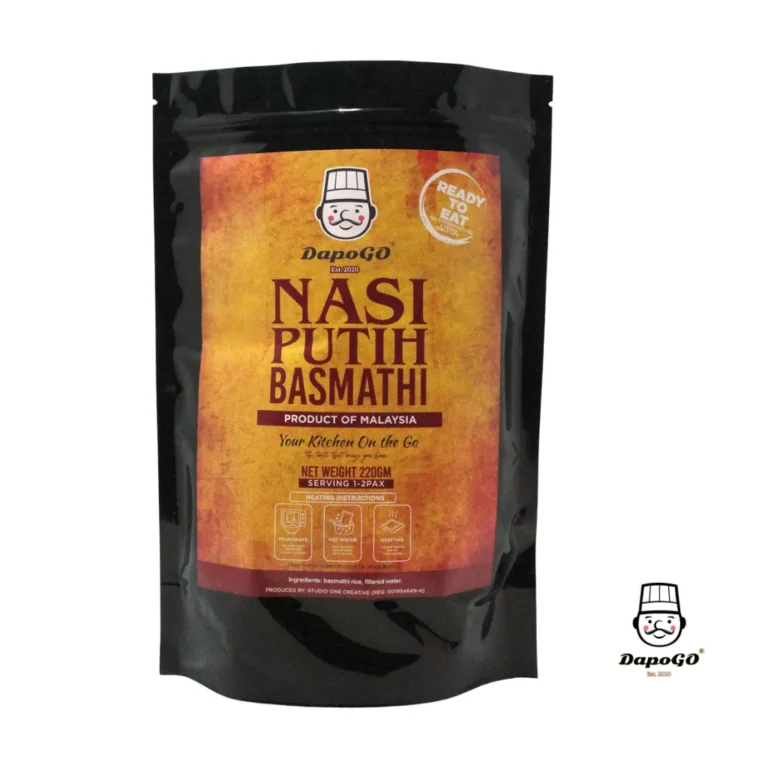
Nasi Putih Basmathi, 220gm — more than double the 100 ml hand-luggage allowance, so it travels in checked baggage.
Gravy-filled ready-to-eat pouches do not clear security in hand luggage: GOV.UK counts semi-liquid food as a liquid, and Senai International Airport’s notice gives the limit as 100 ml / 100 grams per container. The five DapoGo packs whose ingredient lists we publish run from 150gm to 220gm. Malaysia Airlines, though, lists ready-to-eat meals as prohibited in either bag, so confirm with your carrier first.
This guide is for tour operators and group leaders carrying halal meals for Muslim travellers, and for anyone flying out of Malaysia with a suitcase of Malaysian food. DapoGo cooks its dishes into sealed retort pouches at its own factory in the Melaka Halal Hub, so the weight, format and ingredient list of every pack are figures we publish ourselves. This page sits inside our guide to when ready-to-eat meals earn their place and covers the airport you leave from; what the receiving country will admit is in our guides to Europe, the UK and Japan, South Korea and Taiwan and umrah and travel. Every rule on this page was checked on 18 October 2026.
Planning a tour and unsure what is practical to carry? Send us the destination, the dates and the headcount and we will suggest a product mix: WhatsApp DapoGo on 011-5501 3391.
Quick summary
- GOV.UK’s hand-luggage guidance counts “liquid or semi-liquid foods, for example soup, jam, honey and syrups” as liquids at airport security.
- GOV.UK states: “At most airports, you cannot take liquids in containers larger than 100ml through security.”
- Senai International Airport’s notice, dated 31 March 2007 for a rule effective 21 May 2007, gives the permitted hand-carry volume as “(100 ml / 100 grams / 3.4 oz)”.
- Malaysia Airlines prohibits “any form of self-heating meals or ready-to-eat meals carried in checked or cabin baggage”, and the same page says seafood “can only be transported as cabin baggage”. Both need putting to the carrier.
- The five DapoGo packs whose full ingredient lists we publish run from 150gm to 220gm, two of them at 180gm — every one above the 100 ml or 100 gram allowance.
On this page8 sections
Can you take ready-to-eat meal pouches in hand luggage on a flight?
A gravy-filled ready-to-eat pouch cannot go through security in hand luggage at most airports, because screening counts it as a liquid rather than as solid food. GOV.UK‘s list of what counts as a liquid names “liquid or semi-liquid foods, for example soup, jam, honey and syrups”. Senai International Airport‘s notice opens its own list with the same category: “Liquid-based food, including drinks, soups, sauces, jams, yoghurts”.
A DapoGo retort pouch is exactly that: a cooked dish in gravy, or a sauced sambal, sealed in a pouch. The officer at the scanner is not reading a brand, they are reading contents and container size. GOV.UK measures it by what the container holds rather than by how much food is inside: “At most airports, you cannot take liquids in containers larger than 100ml through security. This still applies if the container is only part full.” A pack holding 150gm to 220gm of food is necessarily a container larger than 100 ml, so the published net weights are enough to settle it. The Senai notice gives the limit in both units at once: “(100 ml / 100 grams / 3.4 oz)”.
| Product | Published weight | Format | Against the hand-luggage limit |
|---|---|---|---|
| Chili Oil | 150gm | — | Over: the container is larger than 100 ml |
| Sotong Kicap Berempah | 180gm net | Pouch | Over: the container is larger than 100 ml |
| Sambal Jering Atok | 180gm | Aluminium pouch | Over: the container is larger than 100 ml |
| Sambal Kicap Johor | 200gm | Glass bottle | Over: the container is larger than 100 ml |
| Nasi Putih Basmathi | 220gm | Aluminium pouch | Over: the container is larger than 100 ml |
These five are not a recommended group menu and not the whole DapoGo range; they are the five packs whose full ingredient lists we publish, which is what lets you document them at a counter. One accuracy note: for Sotong Kicap Berempah the product page gives 180gm net while the product name and pack label say 200gm. Both figures are over the limit.
The Senai notice gives the instruction plainly: liquids above the permitted volume “are to be packed into the Check-In baggage”. For a group that is the operational answer, subject to the airline rules below.
Know how many meals the group needs covering? Send the destination, the dates and the headcount: WhatsApp DapoGo on 011-5501 3391.
What can go in the cabin instead?
What clears security in hand luggage is dry food and liquid containers of 100 ml or less, not pouches of gravy. Where an airport asks for liquids to be separated, GOV.UK sets out the form: “containers must be in a single, transparent, resealable plastic bag, which holds no more than a litre and measures approximately 20cm x 20cm”.
None of the five packs in the table above is at or under 100 ml, so none of them fits in that bag. The Senai notice says what happens to the rest: “Surrender items that do not fit in the plastic bag to the security staff to be confiscated.” The listed exemptions — medicines, baby food and milk, special dietary requirements — are covered in the questions below.
The limit is not uniform worldwide. GOV.UK states that “The rules for carrying liquids in your hand luggage depend on the airport”, and that some airports now allow up to 2 litres. For a tour leader that is not an opportunity: one transit airport still enforcing 100 ml is enough to lose the meals halfway through a trip. For your own departure airport, check the operator’s own page — for KLIA, Malaysia Airports’ LAG page. The Senai notice quoted here is the Malaysian source that states the 100 ml / 100 gram figure most plainly, and also the oldest: it is dated 2007.
What does Malaysia Airlines say about carrying meal packs?
Malaysia Airlines publishes two lines that bear directly on meal pouches, and both need putting to the carrier before anyone packs. The Malaysia Airlines baggage restrictions page states: “any form of self-heating meals or ready-to-eat meals carried in checked or cabin baggage by passengers or crew are now prohibited on all Malaysia Airlines flights”.
The page then gives examples: “Self-heating meals or ready-to-eat meals include heat packs or self-heating packs such as quick and easy hot pot, rice, and drinks.” Its stated reason follows — “These packs contain dangerous substances such as magnesium powder, iron powder, self-burning solid carbon, or corrosive calcium oxide that emit flammable gas on contact with water.” Note the word “include”: it illustrates the category, it does not limit it. The Malaysia Airlines page does not state whether a pouch heated in boiling water, with no chemical heater in it, falls inside the prohibition. That makes it a question for the carrier, not one for us to answer.
The same page also says something that cuts against the usual advice for seafood: “Seafood, despite being in the perishables category, is not permitted to be checked in because spillage or leakage from the seafood pack can cause corrosion damage to the structure of the aircraft”, and “Seafood can only be transported as cabin baggage.” That line sits under perishables, and the page does not mention shelf-stable retort pouches. So a pack such as Sotong Kicap Berempah falls between two of the carrier’s own lines: over the cabin liquid limit, yet named as not permitted in checked baggage. Do not settle that contradiction yourself at the counter — get it confirmed by the airline before the departure date.
What helps at a counter is not an argument but paperwork: the product page showing the heating method, and the ingredient list. DapoGo’s heating instruction is boiling water — “Panaskan pouch dalam air mendidih selama 2 minit”, heat the pouch in boiling water for two minutes, for Sotong Kicap Berempah. DapoGo also offers a heat pad as a separate add-on; because that restriction names heat packs specifically, confirm before any heat pad goes into a bag. This page quotes Malaysia Airlines only; every carrier sets its own conditions.
What happens once the packs are in the hold?
Once the packs are in checked baggage, the destination’s quarantine rules take over, and those rules do not care which bag the food was in. Japan’s Animal Quarantine Service says its detector dogs are trained to find meat products “in both check-in/carry-on baggages”, and that a traveller who fails to declare meat products later found in their luggage “will be found punishable”.
Meat is the binding restriction. According to Your Europe, travellers entering the EU from a non-EU country “are not allowed to bring any meat or dairy products”. The same table does allow seafood: “Eviscerated fresh fishery products, or prepared or processed fishery products 20 kg or 1 fish (whichever weighs most)”. For Great Britain, GOV.UK states for food from outside the EU that “You cannot bring in: meat or meat products”, and allows up to 20kg of fish per person — but that list specifies “processed fish – must be dried, cooked, cured or smoked”, and squid is not named on it. So a squid pouch bound for the UK needs checking first rather than assuming.
This page does not cover every destination. For South Korea and Taiwan, see what South Korea and Taiwan admit. For Australia and New Zealand we have not published a guide yet; start with the Australian Border Force, which states that “Food items brought into Australia need to be declared on your Incoming Passenger Card if you come by plane, or on the parcels you mail.”
The packs you can document at a counter are the ones whose ingredient lists we publish in full, because that list is what an officer reads. For six other seafood products we are still confirming one ingredient detail before suggesting them for the EU, the UK or Japan. A product mix for a specific group comes through WhatsApp, not from this page.
How should a tour leader pack the meals?
A tour leader has three things to settle before departure: the packs spread into the right checked bags, the paperwork for each pack travelling with it, and the food declared on arrival. The list below is in the order they happen, from the order date to the quarantine counter.
- Order early. DapoGo’s claim for its packs is a shelf life of “2 tahun pada suhu bilik”, two years at room temperature, so meals can arrive weeks before departure with no cold chain. See what retort processing is.
- Spread the packs across participants’ checked bags rather than one suitcase, and put no pack in hand luggage without the airline’s confirmation.
- Ask the airline two things: its position on ready-to-eat meal packs, and its position on seafood packs.
- Keep every pack in its original labelled wrapper so an officer can read the ingredient list.
- Print the product page for each item carried, one copy for the group leader.
- Check the liquid rules at the departure airport, every transit airport, and the return leg.
- Declare the food on the arrival form at the destination.
- If the carrier says no, cut the order back to the meals where halal food is hardest to find, or check another carrier’s position on the same route before booking.
Frequently asked questions
Does a special dietary requirement let the packs into the cabin?
The special-dietary exemption exists, but no official page we checked names a halal diet as one of them. The Senai International Airport notice and GOV.UK both list medicines, baby food or milk, and special dietary requirements as exemptions, without explaining what counts as a special dietary requirement. So ask the airport and the airline first, and do not assume a group’s meals qualify.
What about sambal in a glass bottle?
Sambal Kicap Johor comes in a 200gm glass bottle, so it is over the hand-luggage limit like the pouches and belongs in checked baggage, wrapped in clothing. One difference: its product page says “Selepas botol dibuka, simpan dalam chiller” — keep it chilled once opened — so it suits a hotel with a minibar fridge rather than a long travel day.
Can frozen packs go in hand luggage?
No. GOV.UK states: “You cannot carry frozen liquids in your hand luggage.” DapoGo’s retort pouches do not need freezing anyway. Their room-temperature shelf life is the reason they get picked for travel. See how retort food keeps without preservatives for the detail.
Do transit airports need checking too?
Yes. GOV.UK advises travellers to check the rules at the airport they are flying from and at any other airports they travel through, including the return journey. A group with one transit clears at least three security checks before it gets home, and four if the return leg also transits. The strictest of them is the one that decides.
How to start planning your group’s meals
If you are putting together a Muslim tour to somewhere halal food is scarce or expensive, send us the destination, the dates and the headcount, and we will suggest a product mix for that group: WhatsApp DapoGo on 011-5501 3391. The full range is on our product pages.
Sources
- GOV.UK: Hand luggage restrictions at UK airports — Liquids (accessed 18 October 2026)
- Senai International Airport: New Security Regulation On Hand Luggage For INTERNATIONAL BOUND PASSENGERS, notice dated 31 March 2007 (accessed 18 October 2026)
- Malaysia Airlines: Baggage — Additional restrictions (accessed 18 October 2026)
- European Commission, Your Europe: Meat, dairy and other animal products (accessed 18 October 2026)
- GOV.UK: Bringing food into Great Britain — Meat, dairy, fish and animal products (accessed 18 October 2026)
- Animal Quarantine Service, Ministry of Agriculture, Forestry and Fisheries, Japan: Import of animal products (accessed 18 October 2026)
- Australian Border Force: What food can you bring in? (accessed 18 October 2026)
Want to try DapoGo?
WhatsApp 011-5501 3391